How Many Fish Can You Put in a Tank?
By Yechiel Kuperman, marine biologist · 49 years keeping fish
Quick answer
There is no single magic number of fish per tank, and the famous one-inch-per-gallon rule is wrong.
Stock for the adult size of every fish, not the size sold in the shop, and start with fewer than you think you have room for.
Add fish in small batches, weeks apart, and let ammonia and nitrite tests be the referee.
The numbers
| Tank | Volume | US volume | A sensible community |
|---|---|---|---|
| 20 L desktop tank | 20 L | 5 US gal | One betta on its own, plus a snail if you like |
| 40 L starter tank | 40 L | 11 US gal | Six neon tetras and a few cherry shrimp |
| 60 L community | 60 L | 16 US gal | Eight small tetras plus five pygmy corydoras |
| 100 L community | 100 L | 26 US gal | Ten small tetras, six corydoras, one honey gourami |
Do this — step by step
- Look up the adult size of every fish before you buy it.search the species name plus 'adult size'
- Count the adult centimetres, not the shop centimetres.almost every fish in a shop is a juvenile
- Start with half the number of fish you think the tank can hold.you can always add more later
- Add one small batch every two to three weeks, never all at once.the filter bacteria need time to catch up
- Test ammonia and nitrite weekly while you are still stocking.any reading above zero means stop adding
- Watch the tank at feeding time for chasing, nipping, or hiding.crowding shows up as behaviour first
- Say no to the shop's 'it'll be fine' upsell and come back next month.the fish will still be there
- When the tank starts to look full, stop — it is.
Why does a crowded tank go wrong so fast?
The one-inch-per-gallon rule survives because it is easy, not because it is right. It measures the wrong thing. What limits a tank is not the length of its fish but the waste they produce, and waste tracks body mass.
Mass grows with the cube of length. Double a fish's length and you multiply its weight by roughly eight. A 10 cm fish is not three times a 3 cm fish. It is dozens of times heavier, and it eats and excretes on that scale.
That is why the rule fails mathematically. Ten inches of neon tetra is a light load. Ten inches of goldfish is a sewage problem. The same ruler reading describes two completely different tanks.
Fish excrete ammonia constantly, mostly through their gills, and ammonia harms fish at levels far too small to see or smell. The more fish mass in the water, the faster it accumulates.
Your filter fights back with living bacteria that convert ammonia to nitrite and then to far less harmful nitrate. But that colony is sized to the load it already receives. It cannot instantly process waste it has never met.
Every new batch of fish outruns the colony for days while the bacteria multiply to catch up. Small batches make that gap survivable. A big batch can make it lethal.
Oxygen sets a second, quieter limit. It enters the water mostly at the surface, so a tall narrow tank holds less breathable water than a wide low one of the same volume. Every extra fish shares whatever crosses that surface.
Crowding also works on behaviour. Fish packed too tightly chase, nip, and guard territory, and constant stress wears down their defences against disease. A sick fish in a crowded tank rarely stays the only sick fish.
Add one more trap: shops sell juveniles. That tidy 3 cm common pleco is headed for 30 cm and beyond. Stocking maths done on shop size becomes fiction within a year.
So the honest method is boring and reliable. Count adult sizes, favour small fish, stock slowly, and let your test kit tell you whether the system is keeping up.
By the way, out in the ocean…
Shark. Great whites get the headlines, but the biggest shark of all — the whale shark — is a gentle giant that eats plankton. The open ocean dilutes waste instantly — a shark never meets its own ammonia, a luxury a closed glass box cannot offer.
Jellyfish. Drifting through the sea with no brain and no heart — and some kinds glow with their own light. Jellyfish blooms take off when overloaded, nutrient-rich water tips an ecosystem — a crowded tank tips the same way, just smaller.
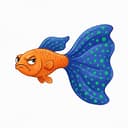
Turbo’s Logbook Card
Zebra danio · resident fact-checker
I checked the maths! Twice! A fish that doubles in length gets about eight times heavier, which means about eight times the waste, and I checked that too!
The filter bacteria can only eat what they are used to. Add six fish at once and the ammonia gets ahead of them for days. Days!
So here is my system: buy a small batch, wait two weeks, test the water, then and only then go back to the shop. I have a chart. I have a spare chart.
When the tank looks full, it is full. I counted everyone in here this morning. I checked it before anyone asked!
What goes wrong when people fill a tank
Stocking by the one-inch-per-gallon rule
The rule sounds like maths, so people trust it. But it counts length when the real load is mass, and it says nothing about activity, aggression, filtration, or how much surface the water has for taking in oxygen.
It fails hardest exactly where beginners lean on it: goldfish, plecos, and other heavy-bodied fish that a ruler flatters.
Treat it, at best, as a ceiling to stay well under — never as a target to fill.
Buying juveniles and forgetting they grow
Almost every fish in a shop tank is a baby. The label rarely says so, and the price certainly does not.
Look up the adult size of the species before you pay. If the grown fish will not fit your tank with room to swim, it does not matter how small it is today.
The classic casualties are common plecos, iridescent sharks, and goldfish, all sold at a small fraction of their adult size.
Adding all the fish on day one to a freshly filled tank
A tank filled yesterday has water, a filter, and almost none of the bacteria that make water safe. The first fish start producing ammonia immediately, and nothing is there yet to eat it.
With a full stocking on day one, ammonia climbs for days and the whole community sits in it. This is the 'new tank syndrome' that empties so many first aquariums within a month.
Cycle the tank first, then stock in small batches, weeks apart, with a test kit as your referee.
Questions we get asked
how many fish can I put in a 10 gallon tank
Honestly, fewer than the shop will suggest. A 10 gallon (about 40 L) tank comfortably holds one small school, such as six neon tetras, plus a few shrimp or a snail.
There is no universal number, because species, adult size, and filtration all change the answer. Stock lightly and let weekly water tests confirm you have room.
is the 1 inch per gallon rule true
No. It treats a long fish like a stack of small ones, but mass grows with the cube of length, so one 10 cm fish produces far more waste than three 3 cm fish.
It also ignores activity, aggression, filtration, and surface area. Use adult size, conservative numbers, and water tests instead of the rule.
how many fish is too many
Too many is any number your filter, oxygen supply, and water changes cannot keep up with. The signs are measurable: ammonia or nitrite above zero, nitrate climbing fast, fish gasping near the surface, or constant squabbling.
If the tank looks full to your eye, trust that. It almost certainly is.
can too many fish in a tank kill each other
Yes, though the water usually does the killing before teeth do. Crowding stresses fish, a stressed fish falls sick far more easily, and tight quarters turn mild species territorial.
Chasing, nipped fins, and a fish hiding at feeding time are early warnings. Rehome or upgrade before injuries appear, not after.
how long should I wait between adding fish
Two to three weeks between small batches is a safe rhythm. The bacteria in your filter grow to match the waste they receive, and they need time to catch up after every addition.
Test ammonia and nitrite before each trip to the shop. If either reads above zero, wait until both sit at zero again.
does a bigger filter mean I can keep more fish
It helps, but it is not a licence to crowd. A filter breaks down ammonia. It cannot give fish more room to swim, stop them squabbling, or change the surface area that sets the oxygen supply.
Treat extra filtration as a safety margin, not as extra capacity.
how many fish should I start a new tank with
Start with a small handful of hardy fish, or none at all if you are doing a fishless cycle. A brand new tank has almost no beneficial bacteria, so even a light load can spike ammonia.
Half of what you think is right is a good opening bid. Adding later is easy. Removing is not.
Sources
- UF/IFAS FA031Francis-Floyd, R., Watson, C., Petty, D. & Pouder, D. B. Ammonia in Aquatic Systems. University of Florida IFAS Extension, FA031. View source
- Merck Vet ManualFrancis-Floyd, R., Yanong, R. P. E. & Petty, B. D. Environmental Diseases of Aquatic Animals in Aquatic Systems. Merck Veterinary Manual. View source
Want the original printed guide?
Download the PDFAbout the author

Yechiel Kuperman
Marine Biologist & Aquaculture Mentor
Yechiel has kept fish since he was four — 49 years with tanks — and 30+ years running farms. He mentors fish farmers internationally.
He writes the Yechiel's Fishery Farm books, in which the biology is real and the fish have opinions.
Last checked: