How to Acclimate a New Fish, and How Long It Takes
By Yechiel Kuperman, marine biologist · 49 years keeping fish
Quick answer
Float the sealed bag in the tank for about 15 minutes so the temperatures match, then add small splashes of tank water to the bag over the next 15 to 20 minutes before netting the fish into the tank.
That is about half an hour for most pet-shop fish, and a slow drip over 30 to 60 minutes is kinder for delicate species, shrimp and saltwater animals.
Fish that spent many hours in a shipping box are the exception: get them out of the bag sooner, because the bag water becomes more toxic once it is opened.
The numbers
| Stage | Metric | US units | Why it matters |
|---|---|---|---|
| Tank temperature, tropical community fish | 24–28 °C | 75–82 °F | The bag is matched to this before anything else |
| Floating the sealed bag | about 15 minutes | about 15 minutes | Evens out temperature only. Chemistry cannot pass through plastic |
| Tank water added per splash (cup method) | about 120 mL every 5 minutes | about ½ cup every 5 minutes | Stop when the bag holds roughly double what it started with |
| Mixing time after floating | 15–20 minutes | 15–20 minutes | Hardy pet-shop fish. Delicate species get a slow drip instead |
| Drip rate (drip method) | 2–4 drops per second | 2–4 drops per second | Hobby convention, not a lab figure. Adjust with a knot or valve |
| Water that drip adds in one hour | about 0.5 L | about 1 US pint | At 3 drops a second. Enough to double a small shop bag |
| Bag water poured into your tank | 0 mL | 0 fl oz | Net the fish across. The bag water goes down the sink |
| Lights off after release | about 4 hours | about 4 hours | Retailer guidance. Gives the fish time to find cover |
Do this — step by step
- Turn off the tank light and dim the room before you open anything.The fish has been in a dark bag
- Float the sealed bag in the tank for about 15 minutes.In a shaded corner, never under a lamp
- Shipped for many hours? Net the fish across straight after floating.Add an ammonia binder to the bag first if you have one
- Open the bag and roll the top down so it floats like a collar.
- Add about half a cup of tank water to the bag every five minutes.Until the bag holds roughly double
- Watch the gills and posture the whole time.Rolling or gasping means cut the wait short
- Net the fish gently into the tank and leave the bag water behind.Bag water goes down the sink
- Keep the tank light off for the next few hours.
- Skip feeding until tomorrow, then offer a small pinch.
- Check the new fish morning and evening for the first week.You are learning what its normal looks like
Why can't you just pour a new fish into the tank?
A fish is the same temperature as the water around it. It has no way to warm or cool itself, so a jump of a few degrees changes how fast its whole body runs, from heartbeat to digestion, within minutes.
Its gills are also where it balances salt and water. A freshwater fish's blood is saltier than the water it lives in, so water keeps seeping in and salts keep leaking out, and the gills spend energy pumping those salts back.
Put that fish into water with a different hardness or pH and the gills have to reset how hard they work. They can. They need time.
Floating solves the first problem and does nothing for the second. Heat passes through a thin plastic bag in fifteen minutes or so. Dissolved minerals and acidity cannot pass through plastic at all, so after an hour of floating the bag still holds the shop's water chemistry.
That is why the second stage exists. Small splashes of tank water shift the chemistry a little at a time, and the fish adjusts as it goes.
The bag has its own chemistry, too. Every minute the fish is sealed in, it uses oxygen and breathes out carbon dioxide. Carbon dioxide forms a weak acid in water, so the pH in the bag drifts down. Meanwhile the fish keeps releasing ammonia into a small volume of water with no filter.
Oddly, the falling pH protects it. Ammonia exists in two forms, and low pH keeps most of it as ammonium, the fairly harmless one. At 25 °C and pH 6.0, only about 0.06% of the total is the toxic form, NH₃.
Open the bag and the carbon dioxide escapes. Mix in tank water at pH 7.5 and the toxic share climbs to about 1.8%. That is roughly thirty times more toxic ammonia without a single extra molecule being made.
After a twenty-minute drive home there is very little ammonia in the bag, so a slow mix is safe and the gentle change is worth it.
After a day in a shipping box there can be a lot. A long drip then walks the fish slowly into that spike. A US aquaculture extension guide on shipping fish warns about exactly this and suggests an ammonia binder.
So the clock is only a stand-in. You are matching two different waters, and how long that takes depends on how different they are and how long the fish has been sealed in.
By the way, out in the ocean…
Sea turtle. Ancient mariners — their kind has crossed the oceans for over 100 million years, migrating thousands of kilometres. Cold-stunned sea turtles are warmed back up a few degrees a day, never all at once. It is the same slow-change idea as floating the bag.
Octopus. One of the ocean's cleverest animals: eight arms, three hearts, and skin that changes colour to vanish in plain sight. Octopuses breathe through gills too, and keepers bring new ones in with a long, slow drip because they handle sudden water changes badly.
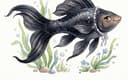
Madame Molly’s Logbook Card
Molly · at home in fresh, salty and in-between water
Sit down, dear. You have just carried someone home in a bag of water from a completely different place, and they would like a moment.
I have lived in fresh water, salt water and the muddy bit in between, and I can promise you every kind of water is perfectly fine once you are used to it. Trouble only comes when somebody hurries.
So float first. Then a splash, then a wait, then another splash. And keep the lights low, please. Nobody looks their best straight out of a bag.
What goes wrong on a new fish's first day
Pouring the fish in, bag water and all
It is the quickest way, and the one the printed guide warns against first. The bag water carries the fish's own waste plus whatever was drifting through the shop's tanks.
Net the fish across, or pour the bag through a net held over a bucket, and let the water go down the sink.
Stopping after the float
Floating matches temperature and nothing else. Skip the mixing and the fish lands in a new pH and hardness all at once, which is the shock the second stage is there to prevent.
Floating the bag under a hot light or in the sun
A small bag of water warms far faster than a whole tank. Float it in a shaded corner with the tank light off, or the bag ends up warmer than the tank instead of matching it.
Dripping an overnight-shipped fish for two hours
The longer you mix, the higher the pH climbs and the more of the bag's ammonia turns toxic.
For fish that spent many hours sealed up, match the temperature, add an ammonia binder to the bag if you have one, and move the fish across sooner.
Dropping an airstone into the bag
Bubbles drive carbon dioxide out of the water, so the pH rises quickly and the ammonia in the bag turns toxic with it. Air belongs in the tank.
Adding a crowd of new fish at once
The filter bacteria are sized for the fish already living there. Add a few fish at a time and give the bacteria a week or two to catch up before the next group.
Questions we get asked
How long should you float a fish bag before releasing the fish?
About 15 minutes, sometimes up to 20 if the bag got cold on the way home. That only matches the temperature.
Then open the bag and add small splashes of tank water over another 15 to 20 minutes, so the fish also adjusts to your water's pH and hardness before you net it into the tank.
What is drip acclimation, and do I need it?
Drip acclimation uses a thin airline tube to trickle tank water into a container holding the fish, at about two to four drops a second, until the volume has doubled.
Hardy pet-shop fish do fine with the cup method. Use a drip for shrimp, saltwater animals and delicate species.
Can you acclimate a fish for too long?
Yes. Oxygen in the bag keeps falling and waste keeps building while you wait. For fish shipped for many hours, a long drip is risky because opening the bag raises the pH and turns stored ammonia toxic.
Around half an hour suits most pet-shop fish, and about an hour at the outside.
Should I put the bag water in my tank?
No. The bag water holds the fish's waste from the journey and whatever was in the shop's system, including any parasites.
Scoop the fish out with a net, or pour the bag through a net held over a bucket, and throw the water away. Only the fish goes into your tank.
How long can a fish stay in the bag from the pet store?
Go straight home and start acclimating as soon as you can. A shop bag holds only the oxygen sealed inside it, and the fish uses that up while waste builds.
A couple of hours is a sensible limit for an ordinary bag. Bags packed with pure oxygen for shipping are built to last much longer.
What happens if you don't acclimate a new fish?
It meets a new temperature, pH and hardness all at once. Some hardy fish survive it. Others go into shock: fast breathing, clamped fins, lying on the bottom or losing balance.
Even a fish that seems fine is more stressed, and stressed fish catch illnesses such as white spot more easily.
When can I feed a new fish and turn the tank light on?
Leave the light off for a few hours after release, so the new fish can find a hiding spot without being chased or dazzled.
Hold food back until the next day. A stressed fish often ignores its first meal, and uneaten food only fouls the water. Start with a small pinch.
How do you acclimate shrimp and snails?
More slowly than fish. Shrimp are especially sensitive to changes in hardness and pH, so drip acclimation over about an hour is the usual approach, with the shrimp in a small container.
Snails are hardier but still benefit from the same float-then-mix routine. Never drop either straight in.
Do I need to quarantine a new fish?
It is the safest habit. A separate small tank for two to four weeks lets hidden illness show itself before it reaches your other fish.
At tropical temperatures the white spot parasite completes its life cycle in about three to six days, so a few weeks covers several cycles.
How many new fish can I add to my tank at once?
Only a few at a time. The bacteria in the filter that break down ammonia grow to match the fish already in the tank.
A big group all at once produces more waste than they can handle, and ammonia rises. Wait a week or two between groups, and test the water in between.
Sources
- SRAC 3903Watson, C., Kilgore, K. H. & Martinez, C. (2010). Shipping Fish in Boxes. Southern Regional Aquaculture Center, Publication No. 3903. View source
- UF/IFAS FA031Francis-Floyd, R., Watson, C., Petty, D. & Pouder, D. B. Ammonia in Aquatic Systems. University of Florida IFAS Extension, FA031. View source
- Emerson et al. 1975Emerson, K., Russo, R. C., Lund, R. E. & Thurston, R. V. (1975). Aqueous ammonia equilibrium calculations: effect of pH and temperature. Journal of the Fisheries Research Board of Canada 32(12), 2379–2383. View sourceNote: The 0.06% and 1.8% figures in this article are calculated from this paper's equilibrium equation at 25 °C, not quoted from it.
- UF/IFAS FA006Francis-Floyd, R., Yanong, R. P. E. & Pouder, D. B. Ichthyophthirius multifiliis (White Spot) Infections in Fish. University of Florida IFAS Extension, FA006. View source
- LiveAquariaLiveAquaria. Acclimation Procedure for Aquatic Life: Welcoming Home New Arrivals. View sourceNote: Retailer guidance, not peer-reviewed. Used only for the four-hours-lights-off figure and the warning against airstones in the shipping bag.
Want the original printed guide?
Download the PDFAbout the author

Yechiel Kuperman
Marine Biologist & Aquaculture Mentor
Yechiel has kept fish since he was four — 49 years with tanks — and 30+ years running farms. He mentors fish farmers internationally.
He writes the Yechiel's Fishery Farm books, in which the biology is real and the fish have opinions.
Last checked: