Ammonia in a Fish Tank: Where It Comes From and How to Fix It
By Yechiel Kuperman, marine biologist · 49 years keeping fish
Quick answer
Ammonia is the waste every fish tank makes: fish release it through their gills, and uneaten food and dead plants rot into it.
It is invisible, so crystal-clear water can still be damaging your fish's gills.
A healthy, established tank reads zero, and the fix for any reading above zero is to skip a day's feeding, change about a quarter of the water, and find out why the filter bacteria fell behind.
The numbers
| Your tank | Toxic NH₃ inside that 1 mg/L | On a ppm kit | What it means |
|---|---|---|---|
| pH 6.5 | about 0.002 mg/L | about 0.002 ppm | Almost all of it is the milder ammonium form |
| pH 7.0 | about 0.006 mg/L | about 0.006 ppm | Below the damage line, but still a job for today |
| pH 7.5 | about 0.02 mg/L | about 0.02 ppm | Closing in. Stop feeding and change water |
| pH 8.0 | about 0.05 mg/L | about 0.05 ppm | Right where gill damage begins |
| pH 8.5 | about 0.15 mg/L | about 0.15 ppm | Three times past the damage line |
| pH 8.0 in a warmer 28 °C (82 °F) tank | about 0.065 mg/L | about 0.065 ppm | Warmth pushes more of it into the toxic form |
| Where damage starts (NH₃ alone) | 0.05 mg/L | 0.05 ppm | Sensitive fish typically die around 2 mg/L |
Do this — step by step
- Test total ammonia and pH together, never ammonia on its own.The pH decides how toxic the number is
- If ammonia reads above zero, skip the next feed.A day or two off food won't hurt healthy adults
- Change about a quarter of the water, dechlorinated and matched to the tank temperature.Repeat tomorrow rather than doing it all at once
- Scoop out uneaten food, dead leaves and anything else that is rotting.
- Check the filter is running and hasn't been rinsed under the tap lately.Chlorine kills the bacteria that eat ammonia
- Test a glass of your tap water once, so you know what you start with.Some suppliers add chloramine, which carries ammonia
- Test again 24 hours later and write both numbers down.
- Once it reads zero, feed only what disappears in a few minutes.Yechiel's feeding rule, and the best prevention
Where does the ammonia in a fish tank come from?
Most of it comes out of the fish. When a fish digests protein, the leftover nitrogen has to go somewhere, and a fish gets rid of most of it as ammonia, straight out through its gills into the water.
In a river that is a sensible design, because the current carries the waste off in seconds. In a glass box, the water a fish breathes out into is the same water it breathes in next.
The rest comes from anything rotting. Uneaten food, a dead snail, a melting plant leaf: bacteria break down the protein in all of it and release ammonia as they go. UF/IFAS names the feed a fish eats as the primary source, with rotting feed adding more on top.
Ammonia hurts because of where it lands. A gill is a thin, feathery sheet with blood running just beneath it, built to let gases cross easily. Ammonia crosses easily too. UF/IFAS reports tissue damage starting at 0.05 mg/L of the toxic form.
That phrase, the toxic form, is the part most people miss. Dissolved ammonia flips between two shapes. Ammonium (NH₄⁺) carries an electric charge and crosses a gill poorly. Free ammonia (NH₃) has no charge and slips through, and UF/IFAS rates it about 100 times more toxic.
pH decides the split, and temperature nudges it. At pH 7 and 25 °C, about half a percent of the total is NH₃. At pH 8 it is over 5%. Each step up the pH scale multiplies the dangerous share roughly tenfold.
Your test kit can't see the difference. It reports total ammonia, both forms added together. The same colour on the card can mean keep an eye on it in soft, acidic water and act today in hard, alkaline water. That is what the table above is for.
It also explains a nasty trap. A neglected tank with a low pH can hold a lot of ammonium quietly. A big water change with higher-pH tap water flips part of it into NH₃ in one go, and fish that seemed fine can go downhill after what felt like a kind thing to do.
The tank's real defence is alive. Bacteria in the filter sponge and on every surface eat ammonia and turn it into nitrite, then a second group turns nitrite into nitrate, which is far milder. That relay is the nitrogen cycle.
Active carbon, which Yechiel's printed guide recommends, polishes the water. It pulls out dissolved compounds that tint and scent it, and the tank looks cleaner for it. Ammonia is one thing it grabs poorly. The bacteria handle that.
So the printed rule holds from every angle. When something seems wrong with the fish, check the water first. And when you check it for ammonia, check the pH in the same sitting.
By the way, out in the ocean…
Shark. Great whites get the headlines, but the biggest shark of all — the whale shark — is a gentle giant that eats plankton. Sharks keep waste urea in their blood on purpose, to balance the salty sea. Your fish do the opposite and dump ammonia out through the gills.
Axolotl. The internet's favourite smiling amphibian can regrow a whole lost leg — yet in the wild it is critically endangered. An axolotl's gills are feathery fronds outside its head, fully exposed to whatever ammonia is in the water around it.
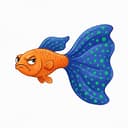
George the Cranky Guppy’s Logbook Card
Guppy · Brackish Bog, gills flaring
Let me be clear about something. The water looked fine. Everyone said so. Lovely and clear, they said, while I sat in the corner with my gills stinging like I had inhaled a pepper.
Ammonia is invisible. That is its entire trick. You cannot see it, you cannot smell it at the levels that sting a gill, and the fish in question cannot file a complaint. I am filing one now.
So test it. Test the pH at the same time, because the number on your little card means nothing on its own. And stop dropping food on my head that nobody is going to eat. I am a guppy, not a compost heap.
What goes wrong when people fight ammonia
Trusting clear water
Ammonia dissolves completely and has no colour. A tank can look like polished glass and still read high enough to damage gills.
Yechiel's printed guide says it in one line: clear water is NOT the same as clean water. Only a test tells you which one you have.
Testing ammonia and ignoring pH
The kit's number is total ammonia. Without the pH beside it, you can't tell whether that reading is a mild warning or an emergency.
Test both every time and write them down together. Two numbers on one line are worth more than a page of guesses.
Changing most of the water at once
A huge change swings temperature, hardness and pH together. In an old, acidic tank, that pH jump can turn stored ammonium into toxic NH₃ exactly when you meant to help.
A quarter at a time, dechlorinated and temperature-matched, repeated daily if needed, gets the number down without the shock. UF/IFAS gives 25–50% as the useful range.
Scrubbing the filter clean
A spotless sponge is a sponge with no ammonia-eating bacteria left in it. Tap water finishes the job, because the chlorine kills them outright.
Squeeze the sponge in a bucket of old tank water and stop while it still looks a bit brown. Take the dirt, keep the biology.
Reaching for a bottle instead of the cause
Some water conditioners claim to lock ammonia into a safer form for a while. UF/IFAS lists binders as short-term relief, and that is the right way to see them.
The fish, the food and the rot will make more ammonia tomorrow. Less food, water changes and a healthy filter are what bring it to zero and keep it there.
Questions we get asked
What level of ammonia is safe for fish?
Zero is the reading to aim for in an established tank. Gill damage begins when the toxic un-ionised form reaches 0.05 mg/L, and how much of your total reading is that form depends on pH and temperature.
Treat any reading above zero as a job for today, not next weekend.
Why is there ammonia in my fish tank?
Because fish make it all the time. They release it through their gills as they digest food, and uneaten food and dead plants add more as they rot.
A reading above zero means production has outrun the filter bacteria, usually from overfeeding, a new tank, a freshly cleaned filter or too many fish.
How do I get rid of ammonia in my fish tank fast?
Change about a quarter of the water with dechlorinated water at the same temperature, and skip feeding for a day. Remove anything rotting.
Test again in 24 hours and repeat the change if you need to. Fixing the cause, usually food or a disturbed filter, is what keeps the number down.
Can a fish tank look clear and still have ammonia?
Yes, easily. Ammonia dissolves completely and has no colour, so water can look like glass and still damage gills.
Cloudy water has other causes. Yechiel's printed guide puts the whole idea in one line: clear water is not the same as clean water. Only a test kit tells you which you have.
Does tap water have ammonia in it?
It can. Some water suppliers disinfect with chloramine, a mix of chlorine and ammonia, and a basic dechlorinator breaks it apart and leaves the ammonia behind.
Test a glass of tap water once. If it reads above zero, a cycled filter will usually cope, and at least you'll know where the number came from.
What are the signs of ammonia poisoning in fish?
Fish gasp at the surface, breathe fast, go off their food, and sit still with fins clamped. Worse cases can show red, inflamed-looking gills.
None of those signs belongs to ammonia alone, which is why the answer is always to test the water rather than guess from the symptoms.
Does activated carbon remove ammonia?
Only in trivial amounts. Carbon is excellent at polishing water, pulling out tints, odours and many dissolved chemicals, which is why Yechiel's guide recommends it.
Ammonia is removed by the filter bacteria. If a tank has an ammonia problem, the fix is less food, water changes and a healthy filter.
Is ammonia or nitrite worse for fish?
Both are dangerous and both should read zero. Ammonia burns the gills directly. Nitrite gets into the blood and stops it carrying oxygen, so a fish can suffocate in well-aerated water.
A new tank usually shows ammonia first and nitrite later, which is why you test for both.
Sources
- Aquarium Basics, Part 4Kuperman, Y. Aquarium Basics, Part 4 of 9: Waste and Ammonia. Yechiel's Fishery Farm care guide (PDF). View source
- UF/IFAS FA031Francis-Floyd, R., Watson, C., Petty, D. & Pouder, D. B. Ammonia in Aquatic Systems. University of Florida IFAS Extension, FA16/FA031. View source
- Emerson et al. 1975Emerson, K., Russo, R. C., Lund, R. E. & Thurston, R. V. (1975). Aqueous ammonia equilibrium calculations: effect of pH and temperature. Journal of the Fisheries Research Board of Canada 32(12), 2379–2383. View sourceNote: The table's NH₃ figures are computed from this paper's equation for fresh water. Kits that report ammonia as nitrogen (NH₃-N) read slightly differently, but the pH effect is the same.
- Merck Vet ManualFrancis-Floyd, R., Yanong, R. P. E. & Petty, B. D. Environmental Diseases of Aquatic Animals in Aquatic Systems. Merck Veterinary Manual. View source
Want the original printed guide?
Download the PDFAbout the author

Yechiel Kuperman
Marine Biologist & Aquaculture Mentor
Yechiel has kept fish since he was four — 49 years with tanks — and 30+ years running farms. He mentors fish farmers internationally.
He writes the Yechiel's Fishery Farm books, in which the biology is real and the fish have opinions.
Last checked: