How Much to Feed Fish (Less Than You Think)
By Yechiel Kuperman, marine biologist · 49 years keeping fish
Quick answer
Feed most adult aquarium fish once a day, and only as much as they eat completely in a few minutes.
If food reaches the gravel and stays there, you fed too much, and that leftover food rots into ammonia and uses up oxygen.
Healthy adult fish can skip a day or two without harm, but fry and very young fish need small meals several times a day.
The numbers
| What | Amount | US | Why it matters |
|---|---|---|---|
| How often, adult fish | once a day | once a day | UF/IFAS: plenty for most pet fish, at least five days a week |
| How much, adult fish | 0.5–1% of body weight a day | 0.5–1% of body weight a day | Ten 1 g fish need only 50–100 mg of food a day between them |
| The timing test | gone in a few minutes | gone in a few minutes | Yechiel's rule: food on the bottom means too much |
| Fry and young fish | small meals, several a day | small meals, several a day | They grow fast and need steady fuel |
| A safe break for healthy adults | 1–3 days without food | 1–3 days without food | UF/IFAS: no harm, except to fry |
| 1 g of 40%-protein flake, fully broken down | about 0.9 mg/L ammonia-N in a 40 L tank | about 0.9 ppm in an 11 US gal tank | Before the filter removes any of it |
Do this — step by step
- Feed once a day, at roughly the same time.Fish learn the routine within days
- Drop in a small pinch, less than they look like they want.
- Watch them eat it, and count heads while you do.The best daily health check you have
- Stop as soon as food starts drifting down uneaten.
- Net or siphon out anything still lying there after a few minutes.
- Give bottom feeders a sinking pellet of their own.Leftovers are not a diet
- Pick one person as the feeder, or use a marked daily pill box.Double feeding is the classic family mistake
- Let adult fish have one day a week off.UF/IFAS: at least five feeding days a week
- If ammonia reads above zero, skip a day and test again.
Why does a little extra food do so much damage?
Because most of the nitrogen in fish food ends up in the water. Fish farming research puts it at 50 to 70 percent. The food a fish digests comes back out through its gills as ammonia. The food it never eats rots, and bacteria turn that into ammonia too.
Aquaculture engineers have a formula for this. Ammonia-nitrogen produced is roughly the weight of feed, times its protein fraction, times 0.092 (Ebeling et al., 2006). Run it for one gram of a typical 40%-protein flake and you get about 37 mg.
Spread that through a 40-litre tank, about 11 US gallons, and it comes to roughly 0.9 mg/L, if the filter removed none of it. A cycled filter removes it steadily. It can only keep pace with the load it is used to, though, and an extra pinch every day is a load it has never met.
Uneaten food does double damage, because it takes oxygen as well. The bacteria breaking it down breathe, and a rotting pile in the gravel keeps them breathing all night. Plecy's list in the printed guide is exactly right: it sinks, it rots, it makes ammonia, it lowers the oxygen.
Now the other side. How much does a fish need? UF/IFAS gives 0.5 to 1 percent of body weight a day for maintenance. Ten small fish weighing a gram each need 50 to 100 milligrams of food a day between them.
That is a modest amount, and it can look bigger than you'd expect, because flakes weigh almost nothing. UF/IFAS suggests weighing the food once to calibrate your eye, so you don't underfeed by accident either.
Fish run on very little because they are ectotherms. They spend no energy keeping warm, and water holds most of their weight up for them. A fish in cooler water runs slower still and needs less again.
So why do they always act starving? In the wild, food turns up unpredictably, so eating whenever it appears is a sound bet. In a tank, that instinct meets a person with a tub of flakes, and fish learn fast. Many rush the glass the moment anyone walks up.
Fry are the exception. Young fish grow quickly and have tiny stomachs, so they need small meals several times a day. Everything else on this page is about adult fish.
By the way, out in the ocean…
Blue whale. The largest animal that has ever lived — bigger than any dinosaur — and it grows that big on a diet of tiny krill. Blue whales feast in summer and eat little on long migrations. A healthy fish skipping a day is a very small version of the same thing.
Seahorse. The fish that swims standing up — and among seahorses, it is the dads that carry the babies. Seahorses have no true stomach, so food passes through fast and they graze all day. Most tank fish do fine on one sensible meal.
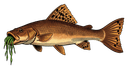
Plecy’s Logbook Card
Plecostomus · glutton, reformed, mostly
A little mess is a little lunch. I said that for years, usually with my mouth pressed to the glass, and I still stand by the first half of it.
Here is what I have learned from the bottom of the tank, where all the leftovers end up. Food nobody eats does not stay food for long. By morning it is a grey, fuzzy smudge, and the filter is working overtime to clear up after it.
So give the fish above me a small pinch and watch it disappear. Give me one proper sinking wafer of my own. I will look as if I am starving anyway. Ignore me. I am a plecostomus. We always look like that.
What goes wrong at feeding time
Two people feeding the same fish
One parent feeds before school, a child feeds after, and a grandparent adds a pinch at the weekend. Nobody overfed. The tank got three meals.
Pick one feeder, or keep a daily pill box with one pinch in each compartment. An empty box means the fish have eaten.
Feeding until they stop begging
Fish don't stop. Begging is instinct plus a learned habit, and it tells you the fish knows where food comes from. It says almost nothing about how much the fish needs.
Use the clock and the gravel instead. Gone in a few minutes, nothing on the bottom: that was the right amount.
Leaving bottom feeders to live on scraps
Corydoras and plecos are often bought as a clean-up crew. A tank run on leftovers either starves them or relies on overfeeding everyone else.
Feed them a sinking food on purpose, then trim the pinch up top.
Dropping in a holiday block before a weekend away
Slow-release blocks can dissolve into the water faster than the fish eat them. For two or three days, healthy adults usually do better with nothing.
For longer trips, leave pre-measured portions and one clear instruction for whoever is feeding.
Starving fish to fix dirty water
A day off food helps when ammonia is up. Weeks of near-nothing is a different problem, and UF/IFAS warns about it. Fix the water with water changes and a working filter, then feed sensibly.
Questions we get asked
How much should I feed my fish?
Only what they eat completely in a few minutes, once a day for most adult fish. If flakes drift to the gravel and stay there, that was too much.
As a number, UF/IFAS gives 0.5 to 1 percent of the fishes' body weight a day, which is less food than most people expect.
How often should I feed my fish?
Once a day is plenty for most adult aquarium fish, and UF/IFAS suggests feeding on at least five days a week.
Fry and young fish are different. They grow quickly and need small meals several times a day. Pick a time and stick to it, and your fish will learn the routine.
Can you overfeed fish?
Yes, and it is one of the most common mistakes in fishkeeping. Uneaten food rots on the bottom, releasing ammonia and using up oxygen.
Yechiel's printed guide warns that overfeeding can do real damage in hours. A little less food is almost always safer than a little more.
How long can fish go without food?
Healthy adult fish can go one to three days without food with no harm, according to UF/IFAS, and many manage longer. Fry can't.
For a weekend away, most adults are fine unfed. For longer trips, ask someone to feed small, pre-measured portions and nothing more.
Why do my fish always act hungry?
Eating whenever food appears is a sensible instinct for a fish, and they learn fast. Many rush the glass the moment a person walks up, fed or not.
Begging tells you the fish knows where food comes from. It says very little about how much food the fish needs.
What happens to uneaten fish food?
It sinks, softens and rots. Bacteria break it down, releasing ammonia into the water and using up oxygen as they work. By the next morning it often has a fuzzy coating.
Remove leftovers with a net or siphon after a few minutes, and feed less next time.
How much should I feed baby fish?
Young fish need small meals more often, several times a day, each gone within a couple of minutes.
The total still has to stay within what the filter can process, so keep testing ammonia while you raise them. Tiny, frequent and cleaned up is the pattern that works.
Do bottom-feeding fish eat leftovers?
Some, but they shouldn't be your clean-up plan. Corydoras, plecos and other bottom dwellers need their own sinking food.
A tank run on leftovers either starves them or depends on overfeeding everyone else, which fouls the water. Feed them on purpose, and trim the pinch at the top.
Sources
- Aquarium Basics, Part 6Kuperman, Y. Aquarium Basics, Part 6 of 9: Feeding, Less Than You Think. Yechiel's Fishery Farm care guide (PDF). View source
- UF/IFAS FA096Francis-Floyd, R. Fish Nutrition. University of Florida IFAS Extension, VM114/FA096. View sourceNote: The source for 0.5–1% of body weight a day, one feeding a day, at least five days a week, overfeeding as the most common owner mistake, and the warning against accidental underfeeding.
- UF/IFAS FA031Francis-Floyd, R., Watson, C., Petty, D. & Pouder, D. B. Ammonia in Aquatic Systems. University of Florida IFAS Extension, FA16/FA031. View sourceNote: The source for 1–3 days without food doing no harm to fish other than fry.
- Ebeling et al. 2006Ebeling, J. M., Timmons, M. B. & Bisogni, J. J. (2006). Engineering analysis of the stoichiometry of photoautotrophic, autotrophic, and heterotrophic removal of ammonia-nitrogen in aquaculture systems. Aquaculture 257(1–4), 346–358. View sourceNote: An aquaculture engineering estimate for feed that is eaten. The 1 g / 40 L figure applies it to a home tank to show scale, not to predict a test reading, because a cycled filter removes ammonia continuously.
- Ramli et al. 2020Ramli, N. M., Verreth, J. A. J., Yusoff, F. M., Nurulhuda, K., Nagao, N. & Verdegem, M. C. J. (2020). Integration of algae to improve nitrogenous waste management in recirculating aquaculture systems: a review. Frontiers in Bioengineering and Biotechnology 8, 1004. View sourceNote: The source for 50–70% of feed nitrogen becoming waste, in fish farming systems.
Want the original printed guide?
Download the PDFAbout the author

Yechiel Kuperman
Marine Biologist & Aquaculture Mentor
Yechiel has kept fish since he was four — 49 years with tanks — and 30+ years running farms. He mentors fish farmers internationally.
He writes the Yechiel's Fishery Farm books, in which the biology is real and the fish have opinions.
Last checked: