Books That Teach Kids About Nature (Without Lying to Them)
By Yechiel Kuperman, marine biologist · 49 years keeping fish
Quick answer
A good nature book for children names real species, draws animals with the right number of legs, and tells you where its facts came from.
You can check all three in about thirty seconds in a bookshop: an expert credit on the copyright page, sources or a glossary at the back, and one picture you can count.
Honeybee, Over and Under the Pond and A Seed Is Sleepy pass easily, and a book that fails two checks should be read as a story.
The numbers
| Book | Ages | Why it passes |
|---|---|---|
| Owl Moon by Jane Yolen, illustrated by John Schoenherr | 3–7 | The 1988 Caldecott Medal winner. A story, and a truthful one: a child and her father go owling on a snowy night and have to keep quiet |
| Lifetime: The Amazing Numbers in Animal Lives by Lola M. Schaefer, illustrated by Christopher Silas Neal | 4–8 | Counts what 11 animals do in a lifetime, then explains the numbers at the back. Easy to check at home |
| The Big Book of Bugs by Yuval Zommer | 4+ | Names its science editor, Barbara Taylor. Beetles, bees, spiders and snails, with life cycles and camouflage |
| Creekfinding: A True Story by Jacqueline Briggs Martin, illustrated by Claudia McGehee | 4–9 | A buried Iowa creek dug back out, and the brook trout, insects and birds that came back. From a university press |
| Over and Under the Pond by Kate Messner, illustrated by Christopher Silas Neal | 5–8 | Life above and below a mountain pond, from minnows to beavers, with a glossary of the animals and plants at the back |
| A Seed Is Sleepy by Dianna Hutts Aston, illustrated by Sylvia Long | 5–10 | From tiny redwood seeds to giant coconuts. Poetic on top, real botany underneath |
| Honeybee: The Busy Life of Apis Mellifera by Candace Fleming, illustrated by Eric Rohmann | 6–9 | Winner of the 2021 Sibert Medal for informational books. Follows one worker bee through her short life and uses her scientific name |
| Seashells: More Than a Home by Melissa Stewart, illustrated by Sarah S. Brannen | 6–9 | Thirteen real shells and the jobs a shell does besides protection, from camouflage to warning colours |
| Butterfly Eyes and Other Secrets of the Meadow by Joyce Sidman, illustrated by Beth Krommes | 6–12 | Riddle poems, each followed by a page of science notes. Proof that a poem and an accurate fact can share a spread |
Do this — step by step
- Open the copyright page and look for a named science consultant, editor or reviewer.5 seconds
- Read the author note: has this person studied, kept or walked the thing they wrote about?5 seconds
- Flip to the back for sources, a glossary or further reading.5 seconds
- Find one animal or plant named by species, not just "a bird" or "a fish".5 seconds
- Count the legs on one bug: six for an insect, eight for a spider.5 seconds
- Photograph one number and check it against a museum or university site at home.5 seconds in the shop
- If the book fails two checks, buy it as a story or leave it on the shelf.
- Hand the leg-counting check to your child and let them run it on every new book.They will enjoy catching a grown-up out
Do children believe what nature books tell them?
Yes. And from about the age of four, they carry it out of the book and into the garden.
In 2011, Patricia Ganea, Lili Ma and Judy DeLoache read preschoolers a picture book about colour camouflage in frogs and lizards. Afterwards, 4-year-olds could say which of two new animals a hungry bird would spot first, and they managed it with real animals, not just pictures.
That transfer from page to world is the whole point of a nature book. Nothing in it checks the fact first. A child who reads that bats are blind has no reason to doubt it, and bats can see perfectly well.
A 2018 review by Gabrielle Strouse, Angela Nyhout and Patricia Ganea adds a twist. Pictures that look like the real thing, closer to a photograph than a cartoon, help children link what is on the page to what is outside. Realistic art with wrong details is therefore the most convincing kind of mistake.
Wrong nature books have become cheap to make. In 2023 the New York Mycological Society warned foragers about mushroom guides, sold online, that appeared to be written by AI. In a foraging guide, the society pointed out, a wrong identification can mean life or death.
Children's nature books rarely carry that risk. Their errors are quieter: a spider with six legs, a honeybee with two wings when it has four, an owl out hunting at noon, a whale described as a fish. Each one is small, and a child who meets it twice starts to believe it.
So the checks in the list above are deliberately plain. An expert credit, a source list and a named species all cost a publisher time and money, and a book thrown together in an afternoon usually has none of them. A picture you can count is a check a six-year-old can run.
Seeds make a good test case. A Seed Is Sleepy says some seeds wait a very long time before sprouting, which is true beyond anything a child would guess. In 2005 a team led by Sarah Sallon in Jerusalem germinated a date palm seed about 2,000 years old, found at Masada. They named the seedling Methuselah.
The George the Cranky Guppy books, by this site's author, get the same scrutiny. George is a talking fish in a made-up story, so the plot is fiction. The water he swims in follows real chemistry, written by a marine biologist with 49 years of fish-keeping behind him.
By the way, out in the ocean…
Octopus. One of the ocean's cleverest animals: eight arms, three hearts, and skin that changes colour to vanish in plain sight. Count the arms in any octopus picture. Eight is the only right answer, and it tells you in two seconds whether the illustrator checked.
Sea turtle. Ancient mariners — their kind has crossed the oceans for over 100 million years, migrating thousands of kilometres. A good nature book names which turtle and how far it swims. "A turtle swam a long way" is a story sentence, not a fact.
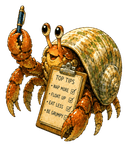
Pinchy’s Logbook Card
Hermit crab · property inspector, reluctantly
Pinchy never moves into a shell without inspecting it first. He turns it over, runs his claws round the opening, checks inside for a previous tenant, and only then swaps. Real hermit crabs do the same, because a bad shell leaves them soft and exposed.
He would like parents to shop for nature books the same way. Turn it over. Check the back. Count the legs on something. A book, he notes, is a place a child moves into for a while, and it ought to be sound before anyone settles in.
What goes wrong when parents buy nature books
Judging the book by how polished the art looks
Glossy, realistic art looks trustworthy, and it is now the easiest part of a book to fake. Check what the art shows instead: the legs, the wings, the right bird in the right place.
A hand-painted watercolour with correct anatomy beats a slick cover with a six-legged spider.
Trusting a name with a very long shelf
Research-based nature books take a long time to make. An author with dozens of titles out in a few months, no biography and no photograph has not had that time.
Look the name up. A real naturalist usually turns up somewhere else too: a university, a museum, a field guide, a school visit.
Reading a poetry book as a field guide
Books like Butterfly Eyes and A Seed Is Sleepy lead with language and keep the hard facts in the notes. Nothing wrong with that.
Read the notes too. Otherwise the child keeps the rhythm and loses the science.
Treating an award sticker as a fact-check
Most picture-book prizes reward art and storytelling. The Sibert Medal is one of the few that judges informational books, and accuracy is part of it.
A sticker is a good sign. It does not replace the thirty seconds with the back pages.
Stopping at the last page
A nature book is a trailer for the real thing. Owl Moon lands hardest on a cold evening outside, even for ten minutes, listening.
Over and Under the Pond needs a pond, or a puddle and a magnifying glass. The book did its job if the child wants to go and look.
Questions we get asked
What are good books to teach kids about nature?
Look for books with named species, sources at the back and an author or editor with real expertise. Owl Moon, Over and Under the Pond, A Seed Is Sleepy, Honeybee and The Big Book of Bugs all pass, and together they cover ages 3 to about 10.
How can I tell if a children's nature book is accurate?
Run five quick checks: an expert credit on the copyright page, a relevant author note, sources or a glossary at the back, one animal named by species, and one picture you can count. Then check a single number at home against a museum or university website.
Are AI-generated children's books bad?
The problem is unchecked facts, whoever or whatever wrote them. Books produced very quickly tend to skip the expert review, source lists and species names that catch mistakes. Run the thirty-second test on any book, and if it fails two checks, treat it as a story rather than a science book.
What age should kids start reading nature books?
From the first picture books. Research by Patricia Ganea and colleagues found 4-year-olds applying biology learned from a book to real animals. Start with simple, accurate books around 3, add ones with back-matter notes by 5 or 6, and keep a real outdoor place in the routine.
Is Owl Moon a nonfiction book?
No, it is a story, and a truthful one. A child and her father go owling on a snowy night, and the quiet waiting is what owling is really like. It won the 1988 Caldecott Medal. Pair it with a nonfiction owl book if your child starts asking questions.
What is the Sibert Medal?
The Robert F. Sibert Informational Book Medal is an American Library Association award for the most distinguished informational book for children each year. Accuracy is part of what the committee weighs. Honeybee by Candace Fleming and Eric Rohmann won it in 2021, which makes it a safe nature pick.
Are the George the Cranky Guppy books nonfiction?
No. They are funny chapter books for ages 7 to 10 with a talking guppy, written by marine biologist Yechiel Kuperman, the author behind this site. The plot is invented. The water chemistry and fish behaviour are real, so they pass the science checks while staying firmly a story.
Sources
- Ganea 2011Ganea, P. A., Ma, L. & DeLoache, J. S. (2011). Young children's learning and transfer of biological information from picture books to real animals. Child Development 82(5), 1421–1433. View sourceNote: 104 preschoolers. Transfer to real animals was tested with 4-year-olds.
- Strouse 2018Strouse, G. A., Nyhout, A. & Ganea, P. A. (2018). The role of book features in young children's transfer of information from picture books to real-world contexts. Frontiers in Psychology 9, 50. View sourceNote: A review of studies, mostly with children under 6.
- NYMS 2023New York Mycological Society (2023). AI generated mushroom books: life and death. Warning to foragers about apparently AI-written foraging guides sold online. View source
- Sallon 2008Sallon, S., Solowey, E., Cohen, Y. et al. (2008). Germination, genetics, and growth of an ancient date seed. Science 320(5882), 1464. View source
- ALA SibertAmerican Library Association. Honeybee: The Busy Life of Apis Mellifera, 2021 Robert F. Sibert Informational Book Medal. View source
About the author
Yechiel Kuperman
Marine Biologist & Aquaculture Mentor
Yechiel has kept fish since he was four — 49 years with tanks — and 30+ years running farms. He mentors fish farmers internationally.
He writes the Yechiel's Fishery Farm books, in which the biology is real and the fish have opinions.
Last checked: