What to Read After The Rainbow Fish
By Yechiel Kuperman, marine biologist · 49 years keeping fish
Quick answer
For ages 4 to 6, the natural next books are Swimmy and Fish Is Fish by Leo Lionni, Mister Seahorse by Eric Carle, or the book's own sequel, Rainbow Fish to the Rescue!
Around 6, add a story where the ocean science is real, such as The Magic School Bus on the Ocean Floor.
From about 7, a first chapter book like Magic Tree House: Dark Day in the Deep Sea keeps the sea and adds a plot long enough to live in.
The numbers
| Book | Ages | Why it comes next |
|---|---|---|
| Rainbow Fish to the Rescue! by Marcus Pfister | 4–8 | The direct sequel, for a child who wants the same fish again. Picks up the theme of belonging |
| The Pout-Pout Fish by Deborah Diesen, illustrated by Dan Hanna | 3–6 | Rhyming, funny, and about a gloomy fish who changes his outlook. Good for the youngest listeners |
| Swimmy by Leo Lionni | 3–7 | Another fable about a fish who looks different, and a 1964 Caldecott Honor Book. The school-of-fish idea is real biology |
| Fish Is Fish by Leo Lionni | 3–8 | A minnow and a tadpole grow up differently. Gills, lungs and metamorphosis, told as a friendship story |
| Mister Seahorse by Eric Carle | 2–5 | Fish fathers who care for the eggs: seahorse, stickleback, tilapia and more. The facts are real |
| The Snail and the Whale by Julia Donaldson, illustrated by Axel Scheffler | 3–7 | A tiny creature and a huge one crossing the sea in rhyme. Same kindness, much bigger ocean |
| The Magic School Bus on the Ocean Floor by Joanna Cole, illustrated by Bruce Degen | 6–9 | The bridge to real science: how fish breathe, food chains, reefs and deep-sea vents, inside a comic-strip field trip |
| Magic Tree House: Dark Day in the Deep Sea by Mary Pope Osborne | 7–10 | A first chapter book set aboard a ship of scientists hunting unknown sea creatures. Great as a read-aloud first |
| The Water Has Opinions by Yechiel Kuperman (our Book 1) | 7–10 | Ours, so weigh this one yourself: a cranky guppy, short chapters, and water chemistry that is real |
Do this — step by step
- Ask what they loved most: the shiny fish, the sea, or the story about friends.The answer picks the next book
- For the sparkle, go to the real science of fish scales and colour.
- For the sea, go to Swimmy, Mister Seahorse or The Snail and the Whale.
- For the friendship story, try Fish Is Fish or Rainbow Fish to the Rescue!
- Read one book with real ocean science before you reach for chapter books.
- Read the first chapter book aloud, long before they read one alone.Listening runs years ahead of reading
- Skip the question about what the book taught them. Let them bring it up.
Could a real fish give away its shiny scales?
Almost every child who hears The Rainbow Fish asks some version of this, and the real answer beats the story. A fish can lose scales. It can also grow them back.
Scales are thin plates of bone that grow in the skin and overlap like roof tiles. A layer of bone-making cells lays each one down. In zebrafish, the species scientists study most, that layer rebuilds within about two weeks of a scale being lost, and a new scale follows.
So the Rainbow Fish could, in principle, share. There is a catch the book skips. On a real fish a missing scale is a small wound and an open door for infection, which is why fishkeepers look hard at any fish with gaps in its scales: fighting, rough decorations or poor water are the usual causes.
The shine is the second surprise. Scales on their own are nearly transparent. The glitter comes from skin cells called iridophores, which stack microscopic plates of guanine crystal, each around 100 nanometres thick, into layers that reflect light like a mirror.
Guanine is one of the four chemical letters of DNA. Fish borrow it for something else entirely. Researchers at the Weizmann Institute in Israel showed that the spacing and angle of those crystal plates decide how silvery a fish looks. Regrown scales rebuild the same careful arrangement.
In the sea, most of that shimmer is for hiding. A silvery side reflects the water around it, so a fish in open water becomes hard for a predator to pick out. The flashiest fish in a picture book is doing, in real life, the opposite of showing off.
Here is why this matters for choosing the next book. A child who loved the sparkle can be handed the real reason for it, and a story about sharing turns into a first step into biology. Nobody has to announce a lesson.
Several books in the table work the same trick. Swimmy's school of small fish swimming as one big one rests on real behaviour: predators struggle to single out one fish from a tight school. Fish Is Fish is a fable about gills. Mister Seahorse is a parade of real fish fathers.
By the way, out in the ocean…
Octopus. One of the ocean's cleverest animals: eight arms, three hearts, and skin that changes colour to vanish in plain sight. The Rainbow Fish takes his problem to a wise octopus. Good casting: octopuses are among the cleverest animals in the sea.
Seahorse. The fish that swims standing up — and among seahorses, it is the dads that carry the babies. Eric Carle's Mister Seahorse is built on this fact, which makes it one of the easiest next reads after The Rainbow Fish.
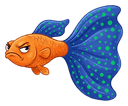
George the Cranky Guppy’s Logbook Card
Guppy · attached to every one of his scales
George has been asked, more than once, whether he would give away his scales. He would not. A scale is part of the skin, he points out, and a missing one is a wound. He is attached to all of his, in every sense.
He concedes that the octopus gave sensible advice. Sharing is good. He merely suggests sharing something that grows back faster, such as the last flake of food at feeding time, which, for the record, he has also never done.
What goes wrong when choosing the next book
Jumping straight to a long chapter book
A child who loved a 32-page picture book is often ready to listen to a chapter book long before they can read one alone.
Read the first one aloud. Hand it over later, once they have met the characters and want more.
Buying every sequel at once
The Rainbow Fish has several sequels, and a child who wants the same fish again should get one of them.
The whole set keeps them in one small sea at the exact moment they were ready to swim further out.
Turning the moral into a quiz
The Rainbow Fish carries its message in plain sight. Asking what did we learn about sharing after every reading teaches children that books are homework with pictures.
Let the story sit. If the idea landed, it will turn up in the playground without your help.
Picking an ocean book with the biology wrong
Fish gulping happily at the surface, a whale drawn as a big fish, a tank with no filter. These pictures are everywhere, and children believe them.
A child who asked about real scales deserves a next book that tells the truth about the animals in it.
Choosing for the child instead of with them
Put three candidates on the table and let them choose. A four-year-old who picked the book listens differently to one who was handed it.
Questions we get asked
What age is The Rainbow Fish for?
The publisher, NorthSouth, lists it for ages 4 to 8, and a board-book edition exists for younger children. In practice it is read aloud most at 3 to 6, which is why the best next book is usually another picture book rather than a chapter book.
Is there a sequel to The Rainbow Fish?
Yes, several. Rainbow Fish to the Rescue! is the best-known, and there are others including Rainbow Fish and the Big Blue Whale. One sequel is a good gift for a child who wants the same fish again. After that, widen the sea with a different author.
What books are like The Rainbow Fish?
Leo Lionni's Swimmy is the closest match: an ocean fable about a fish who looks different. Fish Is Fish, Mister Seahorse by Eric Carle, The Snail and the Whale and The Pout-Pout Fish all share the sea, the bright art and a gentle point about getting along.
Can a fish really give away its scales?
Not as a gift, but a fish can lose scales and regrow them. Scales are thin bony plates in the skin, and in zebrafish the layer that makes them rebuilds in about two weeks. A missing scale is still a small wound, so real fish do not share them happily.
What should a 6-year-old read after picture books about fish?
Try a book that mixes story and real science, such as The Magic School Bus on the Ocean Floor, then read a first chapter book aloud together, like Magic Tree House: Dark Day in the Deep Sea. Most six-year-olds can follow a chapter book by ear before they can read one.
Why do some parents dislike The Rainbow Fish?
Some commentators, including Matt Welch writing in Reason, read the ending as giving up what makes you special in order to be accepted. Others see plain generosity. It is a fair conversation with an older child, and Swimmy, where the different fish keeps his difference, makes a good pairing.
Are the George the Cranky Guppy books a good next step?
Later on. They are chapter books for ages 7 to 10, so for a four-year-old fresh from The Rainbow Fish they are a few years off. From about 6 they work read aloud for a child who wants a longer fish story, with real water science inside.
Sources
- bergen2022Bergen, D. J. M., Tong, Q., Shukla, A. et al. (2022). Regenerating zebrafish scales express a subset of evolutionary conserved genes involved in human skeletal disease. BMC Biology 20, 21. View sourceNote: Zebrafish, the standard laboratory fish. Regrowth speed differs between species and with water quality.
- weizmann-guanineWeizmann Institute of Science (2011). Why fish scales shine. On the guanine crystal reflectors studied by Levy-Lior, Weiner, Addadi and colleagues. View source
- funt2017Funt, N. et al. (2017). Koi Fish-Scale Iridophore Cells Orient Guanine Crystals to Maximize Light Reflection. ChemPlusChem. View sourceNote: Shows regenerated scales rebuild the same crystal orientation, and describes silvery reflectance as camouflage near the surface.
- rainbow-fishPfister, M. (1992). The Rainbow Fish (Der Regenbogenfisch). NordSüd Verlag; English edition NorthSouth Books, translated by J. Alison James. View source
About the author
Yechiel Kuperman
Marine Biologist
Yechiel has kept fish since he was four — 49 years with tanks — and 30+ years running farms.
He writes the Yechiel's Fishery Farm books, in which the biology is real and the fish have opinions.
Last checked: