STEM Picture Books for the Classroom, Chosen for a Class and a Budget
By Yechiel Kuperman, marine biologist · 49 years keeping fish
Quick answer
Build a classroom STEM picture-book shelf by strand, not by cover: a title or two each for life science, earth science, physical science, engineering and maths, plus one real scientist's story.
Buy only the books you will read every year and borrow the rest, unit by unit, from the school or public library.
Before any book goes on the shelf, spend two minutes on it: who wrote it, what the back matter cites, and whether the one fact you would teach from it is right.
Download the printable pack
One page of nine cut-out reading badges, from Cranky Guppy Reader to a gold Fishery Farm Finisher seal, for marking a class's progress through a shelf of books.
Fishery Farm Reading BadgesPDFThe numbers
| Book | Strand | Why it earns shelf space |
|---|---|---|
| Hey, Water! by Antoinette Portis (2019) | Earth science: water in every form | Spare enough for kindergarten, with back matter on solid, liquid and gas for the older end of the room |
| Redwoods by Jason Chin (2009) | Life science: a whole ecosystem | Plain nonfiction text over a fantasy picture story, so it doubles as a lesson in which layer holds the facts |
| Coral Reefs by Jason Chin (2011) | Life science: food chains and adaptation | The same design as Redwoods, set in the sea. Read both and ask what a forest and a reef have in common |
| Energy Island by Allan Drummond (2011) | Physical science and engineering: wind energy | A true story: the Danish island of Samsø, whose people set out to make their own energy from wind and other renewables |
| Rosie Revere, Engineer by Andrea Beaty, illustrated by David Roberts (2013) | Engineering design | Rhyming, funny, and built around a design that does not work first time. The best opening there is for testing and improving |
| Manfish: A Story of Jacques Cousteau by Jennifer Berne, illustrated by Éric Puybaret (2008) | Technology and a scientist's life | The curiosity behind the Aqua-Lung, for the lesson where the class asks who invents things and why |
| How Much Is a Million? by David M. Schwartz, illustrated by Steven Kellogg (1985) | Maths: scale and big numbers | Under 300 words that make a million something you can picture. Science runs on big numbers, and this is where children first feel one |
| Ours: George and the Mosquito Patrol, Book 2 (ages 7–10) | Life science: food webs, life cycles, refraction | Ours, so weigh it yourself. A chapter book for the Grade 2–5 end of the shelf, with free teacher notes and a reading quiz |
Do this — step by step
- List the science units you teach this year before you look at a single book.
- Aim for one or two books per unit, and one real scientist's story for the year.
- Start from the NSTA Outstanding Science Trade Books and Best STEM Books lists.Free, annual, vetted by teachers
- Give every candidate the two-minute check: author, back matter, one fact.
- Buy the few you will read every year and borrow the rest a unit at a time.
- Ask the school librarian to pull a unit's books for you two weeks ahead.
- Keep fiction and nonfiction on the same shelf, labelled, so children learn the difference.
- Retire a book whose facts have gone out of date, however much the class loves it.Keep it for the pictures, not the science
What makes a STEM picture book accurate enough for a classroom?
A parent buying one book for one child can live with a small mistake in it. A classroom copy is read to a new class every year for as long as its spine holds, so one wrong fact gets taught to hundreds of children, in the teacher's voice, with the teacher's authority behind it.
Mistakes in picture books come in three kinds. Some were right when printed and have gone stale. Some are simplifications that tipped over into wrong. And some live only in the pictures: a fish in a bowl with no filter, a spider with six legs, a moon that is the wrong shape for the night the story says.
The stale kind is the hardest to spot, because the book looks confident. Our own field has a good example. For decades, books named Nitrobacter as the bacterium that cleans nitrite out of a freshwater tank.
In 1998 Hovanec and colleagues showed the real worker is a Nitrospira-like bacterium. A book that still says Nitrobacter is simply out of date.
So the two-minute check has three parts. First, who wrote it, and did a scientist check it? Look at the author note and the acknowledgements. Second, what does the back matter cite? A source list, an author's note on the research, or further reading are all good signs.
Third, find the one fact you would actually teach from the book and check it against a source you trust: a government science agency, a museum, a university extension page. If that fact holds, the book is probably careful elsewhere too. If it does not, nothing else on the page is worth the risk.
Illustrations deserve a look of their own, because children remember pictures longer than sentences. Count legs. Look at where the animals live. A book can have perfect text and a drawing that teaches the opposite.
Much of this vetting already exists for free. Since 1973 the National Science Teaching Association and the Children's Book Council have published an annual list of Outstanding Science Trade Books, picked by a panel that looks for substantial science that is clear, accurate and up to date.
A newer companion list, Best STEM Books, adds engineering, technology and maths.
Layered books are worth a place for a reason beyond their facts. Jason Chin's Redwoods and Coral Reefs put straight nonfiction text over an invented picture story. Asking a class which layer is true and which is imagined is a small, early lesson in reading like a scientist.
Budget follows from all this. A dozen well-chosen books, two per strand, cover most of a K–5 science year when you add the library. Buy the anchors you open every September. Borrow the rest when the unit comes round, and let the librarian keep the stock current.
By the way, out in the ocean…
Shark. Great whites get the headlines, but the biggest shark of all — the whale shark — is a gentle giant that eats plankton. A quick shelf test: does your shark book mention the plankton-eating whale shark, or only teeth? Accurate books show the whole family.
Seahorse. The fish that swims standing up — and among seahorses, it is the dads that carry the babies. Seahorse dads carrying the young is a fact picture books love. Check that yours gives the pouch to the right parent before it goes out.
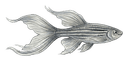
Turbo’s Logbook Card
Zebra danio · resident fact-checker
Turbo has checked the book corner! Twice! He found a fish in a bowl with no filter, a starfish labelled as a fish, and a bubble drawn going the wrong way. He wrote them all down. He has a list.
His method, for anyone who wants it: read the back of the book first. If nobody says where the facts came from, pick one fact and look it up. One is enough. If that one is wrong, put the book back.
He also wishes it known that he is fast, and that checking is still quicker than un-teaching. He checked that too!
What goes wrong when a class shelf is stocked
Buying the whole list in one go
A single order of thirty books spends a year's budget in a day, and half of them sit unread because they belong to a unit you teach once, for two weeks.
Buy the handful you read every year. Borrow the unit books when the unit comes round, and spend what is left on replacing the anchors that wear out.
Choosing by cover and award sticker
A medal on the cover is usually for the art or the writing. It says nothing about whether the science inside is current.
Treat an award as a reason to look, then run the two-minute check anyway.
An all-animals shelf
Animal books are easy to love, so they crowd everything else out, and the class goes a year without a single book about forces, materials or engineering.
Sort the shelf by strand once a term. Wherever a strand is empty, that is the next book to find.
Keeping a loved book whose facts have expired
Old favourites are the hardest to retire, and the ones children trust most. A book that still names Nitrobacter as the tank's nitrite-eater teaches something science has moved past.
Keep it if you must, and use it as a puzzle: what did scientists find out after this book was printed?
Treating fiction as a fact book
Story books with real science in them, ours included, are fiction first. The talking fish is invented even when the water chemistry is right.
Pair each story with a nonfiction title on the same topic, so children can check the story against the facts.
Questions we get asked
How do I choose STEM picture books for my classroom?
Start from your science units, not the bookshop. Aim for one or two books per unit across life, earth and physical science, engineering and maths.
Then check each candidate: who wrote it, what its back matter cites, and whether the one fact you would teach from it is right. The NSTA book lists are a good first filter.
How many STEM books does a classroom library need?
Fewer than you think. About a dozen well-chosen picture books, two per strand, will carry most of a K–5 science year once the school library fills the gaps.
Rotate them by unit, so the books on display always match what the class is studying that month, with library copies filling any gap.
How can I build a classroom STEM library on a small budget?
Buy only the anchor books you read every year, and borrow everything else unit by unit from the school or public library.
Ask whether your public library offers a teacher card with longer loans, and look for paperback editions of the titles you do buy. Spend what is left replacing worn anchors, not adding one-off titles.
What is the NSTA Outstanding Science Trade Books list?
It is an annual list of science books for Grades K–12, chosen since 1973 by a panel from the National Science Teaching Association with the Children's Book Council.
The panel looks for substantial science that is clear, accurate and up to date. A companion list, Best STEM Books, covers engineering, technology and maths too.
How can I tell if a children's science book is accurate?
Check the author note and acknowledgements for a scientist, look for sources or an author's note in the back matter, and note the publication date.
Then check one fact you would teach against a government science agency, a museum or a university page. Look hard at the pictures too, because children remember them longest.
Are fiction picture books OK for teaching science?
Yes, when the science in them is real and you say clearly which parts are invented. A story gives a concept a reason to matter.
Pair each story with a nonfiction book on the same topic, and for the youngest children, name out loud which details are made up and which are true.
What is the difference between this list and your STEM books for parents?
The parent page is for one child who has decided science is boring, and it is about winning that child back with story.
This page is for a teacher stocking a shelf for a whole class on a fixed budget, so it covers strands, accuracy checks and what to buy versus borrow.
Sources
- NSTA OSTBNational Science Teaching Association with the Children's Book Council. Outstanding Science Trade Books for Students K–12 (annual since 1973). View source
- NSTA STEMNational Science Teaching Association with the Children's Book Council. Best STEM Books K–12 (annual). View source
- Hovanec et al. 1998Hovanec, T. A., Taylor, L. T., Blakis, A. & DeLong, E. F. (1998). Nitrospira-like bacteria associated with nitrite oxidation in freshwater aquaria. Applied and Environmental Microbiology 64(1), 258–264. View source
- Hey, Water!Penguin Random House listing. Hey, Water! by Antoinette Portis (Neal Porter Books / Holiday House, 2019). View source
- Coral ReefsMacmillan listing. Coral Reefs by Jason Chin (Flash Point, 2011). View source
- RedwoodsKirkus Reviews. Redwoods by Jason Chin (Flash Point, 2009). View source
- Energy IslandGoogle Books listing. Energy Island: How One Community Harnessed the Wind and Changed Their World by Allan Drummond (Frances Foster Books / Farrar, Straus and Giroux, 2011). View source
- BookrooBookroo listings for Rosie Revere, Engineer (Abrams, 2013) and How Much Is a Million? (292 words), checked September 2026. View source
About the author
Yechiel Kuperman
Marine Biologist & Aquaculture Mentor
Yechiel has kept fish since he was four — 49 years with tanks — and 30+ years running farms. He mentors fish farmers internationally.
He writes the Yechiel's Fishery Farm books, in which the biology is real and the fish have opinions.
Last checked: