Science Read-Alouds for the Classroom: How Long Each Takes and Where to Stop
By Yechiel Kuperman, marine biologist · 49 years keeping fish
Quick answer
A science read-aloud for a class of seven- to ten-year-olds takes 10 to 20 minutes once you add the stops, even when the book itself reads in under five.
Plan two or three stops per book, each just before a page turn, and wait at least three seconds after every question before taking an answer.
The table below times six picture books and one chapter book, and marks where to stop in each.
Download the printable pack
For a serial read-aloud: the science focus of all 12 chapters, an In the classroom question for each one, key vocabulary and four low-prep activities. Spoiler-free, so you can plan before the class hears a word.
Book 1 Teacher Notes: one pause question per chapterPDFThe numbers
| Read-aloud | Straight through | Where to stop |
|---|---|---|
| Water Is Water by Miranda Paul, illustrated by Jason Chin (154 words) | Under 2 min | At each 'unless...' before the page turn: what will the water become next? Keep the back matter for a second day |
| Over and Under the Pond by Kate Messner, illustrated by Christopher Silas Neal (441 words) | About 4 min | At the first dip below the surface: what do you think lives down here? Once more at the end: what do the two worlds share? |
| A Seed Is Sleepy by Dianna Hutts Aston, illustrated by Sylvia Long (577 words) | About 5 min | Day one, read only the big lines. Day two, stop at each spread and read the small print as the answer to its big line |
| Over and Under the Waves by Kate Messner, illustrated by Christopher Silas Neal (638 words) | About 6 min | At the kelp forest and again at the whales: what is this animal eating, and what might eat it? |
| Ada Twist, Scientist by Andrea Beaty, illustrated by David Roberts (943 words) | About 9 min | The first time the word hypothesis comes up: what is yours? Take three before you turn the page |
| Flotsam by David Wiesner (wordless, 2007 Caldecott Medal) | Set by the talk. Plan 15 min | On each photograph the camera turns up: what do you notice, and what is strange about it? Let the class narrate |
| Ours: The Water Has Opinions, Chapter 1 (the recorded reading) | 6 min 54 s, measured | At the end of the chapter, with the question from the teacher notes: how can you tell water is salty without tasting it? |
| Ours: the free Book 1 sample chapter (about 2,200 words) | 15–20 min | Too long for one sitting below Grade 2. Split it in two and stop once in each half |
Do this — step by step
- Read the book once alone, timing it, before the class hears it.Then add two minutes per stop
- Mark two or three stops with sticky notes, each just before a page turn.Predict, notice or explain
- Tell the class whether the book is a story, a set of facts, or both.
- Ask one open question at each stop, then count three seconds in your head.Longer answers start around three seconds
- After the first answer, wait again and ask how they know.
- Keep each stop under two minutes and park bigger questions on the board.
- Read a picture book a second time straight through, with no stops at all.
- For a chapter book, read one chapter a day and end on that chapter's question.The teacher notes give one per chapter
- Finish with one thing the class can check for real: a glass of water, a seed, a map.
Why do stopping and waiting turn a read-aloud into science?
Mary Budd Rowe was a science educator who spent years timing the silences in classrooms. The usual pause after a teacher's question was one second or less. After a child answered, the teacher came back in under a second too.
When teachers stretched both pauses to three seconds or more, the children's answers grew by 300 to 700 percent. More of them backed a claim with evidence, more of them asked questions of their own, and fewer said I don't know. Rowe put the threshold at about 2.7 seconds.
That matters more in science than anywhere. One word in reply to what will happen next is a guess. Three seconds later it tends to come with a because, and a prediction with a reason is the first half of an experiment.
A read-aloud hands you something a worksheet never can. The page is about to turn. Everyone in the room wants to see the next picture, so a question asked just before the turn gets full attention. Asked after it, the question competes with the illustration and loses.
Beck and McKeown built their Text Talk approach for young children around the same idea: open questions during the reading, while the book is still in front of everyone, in place of a quiz at the end. Children put the ideas into their own words while the pictures can still help them.
Too many stops break the thing that makes a book work. Picture books have a rhythm, stories have momentum, and a class asked something on every spread starts waiting for the questions instead of listening. Two or three stops is plenty, and a second reading with none lets the book be a book again.
Stories with talking animals need one extra habit. In a 2014 study, three- to five-year-olds who heard animals described with human words and thoughts learned fewer real facts about them and were more likely to say the animals really behave like people.
That study was with preschoolers, but the fix costs nothing at any age. Say out loud which parts are invented and which are real. In our own books the fish talk, which is made up. The salt, the gills and the bent light are real, and a glass of water proves it.
Last, the clock. Americans talk at about 150 words a minute, according to the National Center for Voice and Speech. Reading to a class, with expression and time for the pictures, runs slower, so the times in the table use 110. Time yourself once and correct them for your own voice.
By the way, out in the ocean…
Jellyfish. Drifting through the sea with no brain and no heart — and some kinds glow with their own light. Moon jellies drift through Over and Under the Waves. Stop on them and ask how an animal with no brain gets anywhere at all.
Octopus. One of the ocean's cleverest animals: eight arms, three hearts, and skin that changes colour to vanish in plain sight. Any page with an octopus on it is a ready-made stop. Ask the class to find it first, then to explain why it was so hard to see.
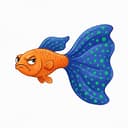
George the Cranky Guppy’s Logbook Card
Guppy · read aloud to whole classes, against his wishes
George has been read aloud to thirty children at once, and he has notes.
First, stop before the page turns. Not after. After, everybody is looking at the picture, and the picture is usually of him looking cross.
Second, when somebody asks a question, wait. George waits for everything, including water that is changing. Three seconds is nothing. He has waited whole afternoons.
Third, do the voices if you must. But when the chapter ends, tell the class plainly that guppies do not talk. The salt is real, though, and so is his opinion of it.
What goes wrong with a science read-aloud
Stopping on every page
A class asked something on every spread stops following the book and starts waiting for the next question. By page ten the pull of the story, the thing that held them, has gone.
Pick the two or three turns that matter, mark them before class, and read everything else without comment.
Asking questions with one right word for an answer
What is this called? gets one hand and one word. Rowe found that at the usual fast pace, six or seven children did more than half the answering while the rest of the room watched.
Ask what they notice, what they predict, or how they know. Those have many right answers, so more children will risk one.
Filling the silence
Three seconds of quiet after a question feels endless from the front of the room. It is also where the good answers come from, and cutting it short teaches the class that you will answer it yourself if they wait.
Count it in your head. Rowe noted how hard teachers found it to get their pauses up to three seconds, so expect it to take practice.
Choosing the book by its cover
A gorgeous book nobody has checked can put wrong science in front of a whole class at once, and children remember the picture long after the page.
Read it alone first, back matter included. Then check the one fact you plan to stop on against a source you trust.
Letting the talking animals carry the science
When animals talk, some children file the whole book under make-believe, facts included, and a few file the make-believe under fact.
Draw the line out loud at the end: the characters are invented, the water is real. Then prove one real thing with a glass, some salt or a straw.
Questions we get asked
How long should a read-aloud be in elementary school?
For Grades K–2, aim for 10 to 15 minutes in total, stops included, which means a picture book of up to about 600 words.
Grades 3–5 can manage 20 minutes, enough for a longer picture book with three stops or one chapter of a chapter book. Time the book yourself once, then add two minutes for each stop.
Where should I stop during a read-aloud to ask questions?
Stop just before a page turn, where the class can predict what comes next, or on a picture with something to notice. Two or three stops is enough for a picture book.
Avoid stopping mid-sentence or in the middle of an exciting scene. The question should feed the story's momentum, not fight it.
How many questions should I ask during a read-aloud?
One open question per stop, and two or three stops per picture book. That is fewer than most plans suggest, and it leaves time for the answers.
Follow each first answer with how do you know, and write any question too big for the moment on the board to come back to after the reading.
What are good science read-alouds for 2nd and 3rd grade?
Water Is Water, Over and Under the Pond, Over and Under the Waves, A Seed Is Sleepy and Ada Twist, Scientist all read in under ten minutes and carry real science.
Flotsam, which is wordless, works well for observation. For a chapter-a-day serial, a short chapter book with teacher notes gives you a ready question for each day.
Can a chapter book work as a science read-aloud?
Yes, read as a serial: one chapter a day, ending on one question. Our Book 1 has 12 chapters, and its recorded Chapter 1 runs 6 minutes 54 seconds.
Longer chapters can run 15 to 20 minutes, so split them for younger classes. Free teacher notes give each chapter's science focus and a question to stop on.
What is wait time and why does it matter in science?
Wait time is the pause after a question, and after a child's answer, before the teacher speaks again. Most teachers wait about one second.
Science educator Mary Budd Rowe found that at three seconds or more, answers grew several times longer, more children took part, and more claims came with evidence attached.
Should I read nonfiction picture books all the way through?
Not always. Many have two layers, a short line for younger listeners and a paragraph of facts. Read the short lines on day one and the facts on day two.
Back matter, the notes at the end, rarely suits a whole-class read-aloud. Use it yourself to check facts, or give it to the children who want more.
Are there free teacher notes for your books?
Yes. Books 1, 2 and 3 each have free teacher notes on the Educators page: the science focus of every chapter, a classroom question for each, key vocabulary and a few low-prep activities.
Each also has a reading quiz with an answer key. The notes are spoiler-free, and no email address is needed to download them.
Sources
- Rowe 1986Rowe, M. B. (1986). Wait time: slowing down may be a way of speeding up! Journal of Teacher Education 37(1), 43–50. View source
- Beck & McKeown 2001Beck, I. L. & McKeown, M. G. (2001). Text Talk: capturing the benefits of read-aloud experiences for young children. The Reading Teacher 55(1), 10–20. View source
- Ganea et al. 2014Ganea, P. A., Canfield, C. F., Simons-Ghafari, K. & Chou, T. (2014). Do cavies talk? The effect of anthropomorphic picture books on children's knowledge about animals. Frontiers in Psychology 5, 283. View sourceNote: Children aged three to five. We apply the finding to older classes as a precaution, not as a measured result.
- NCVSNational Center for Voice and Speech. Voice Qualities (average US English speaking rate about 150 words per minute). View source
- BookrooWord counts for Water Is Water, Over and Under the Pond, A Seed Is Sleepy, Over and Under the Waves and Ada Twist, Scientist, from each title's Bookroo listing, checked September 2026. View sourceNote: Counts may leave out back matter, and editions differ. Time your own copy once.
- KirkusKirkus Reviews. Over and Under the Waves by Kate Messner (kelp forest, whales, moon jellies; author's note and further reading). View source
- ALAAmerican Library Association. Flotsam by David Wiesner, 2007 Caldecott Medal. View source
About the author
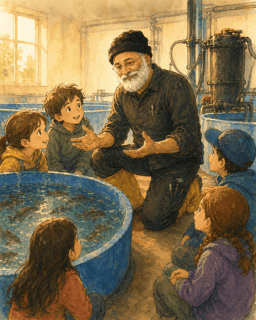
Yechiel Kuperman
Marine Biologist & Aquaculture Mentor
Yechiel has kept fish since he was four — 49 years with tanks — and 30+ years running farms. He mentors fish farmers internationally.
He writes the Yechiel's Fishery Farm books, in which the biology is real and the fish have opinions.
Last checked: