What to Get a Kid Who Wants to Be a Marine Biologist
By Yechiel Kuperman, marine biologist · 49 years keeping fish
Quick answer
Give a future marine biologist the tools of the job: a hand lens, a waterproof notebook and a free nature-ID app for observing and recording what they find.
Add one experience, like an aquarium visit or a tide-pool or pond walk, and one book that shows a real scientist at work.
For holiday delivery of printed books, order by 12 November for Hanukkah and by 3 December for Christmas.
The numbers
| Gift | Ages | Budget, and why a marine biologist would pick it |
|---|---|---|
| A 10× hand lens | 5+ | Under $15. Every field biologist carries one. It turns a shell, a scale or a leaf into something worth drawing |
| A waterproof notebook and a pencil | 6+ | Under $15. Scientists write down what they saw, with the date and the place. Pencil still writes when it gets wet |
| Seek by iNaturalist (app) | Any age, on a grown-up's phone | Free. Point the camera at a plant or animal and it suggests a name. No account, and it does not collect the child's data |
| A day at a public aquarium, with the notebook | 4+ | The price of tickets. Ask for one drawing and three things a fish did. That is a real observation |
| A tide-pool, beach or pond walk with a field guide | 5+ | Free or low cost. Look, photograph, put every rock back the way it was |
| Shark Lady by Jess Keating | 4–8 | The true story of Eugenie Clark, who fell for fish at an aquarium and became a famous shark scientist |
| Book 1, The Water Has Opinions, with its coloring book | 7–10 | $18.83 as a set. A grumpy guppy with real water science. Written by the author of this page |
| An aquarium water test kit (for a family that has a tank) | 8+, with a grown-up | $15 to $40. Testing ammonia, nitrite and pH is daily work in fish labs and fish farms |
| A beginner microscope | 8+ | $40 and up. A drop of pond water shows tiny living things, the freshwater cousins of plankton |
Do this — step by step
- Ask what they love most: the animals, the water, diving, or drawing what they see.
- Choose gifts they can use this week, not someday when they are older.
- Give one tool for observing: a hand lens, a notebook or the Seek app.
- Add one experience: an aquarium, a tide pool, a pond or a natural history museum.
- Add one book that shows a real scientist, or a story with real science in it.
- Wrap a promise of time together, because a planned outing counts as a gift.
- Skip any gift that takes animals out of the wild or brings home a pet nobody planned.Look, photograph, put back
- Order printed books by 12 November for Hanukkah and by 3 December for Christmas.Earlier outside the US
What does a marine biologist actually do all day?
Marine biologists study life in salt water, from plankton too small to see to the great whales. Most of the job is careful watching, measuring and writing down, and much of it happens away from the waves: in labs, at fish farms, in public aquariums and at a computer.
The core skills start young. Notice details. Write them down honestly, with the date and the place. Ask why. Then test the idea. A child who draws the same fish every week, and notes what changed, is already doing the work.
Water is half of the science. A fish's health depends on temperature, oxygen, ammonia and salt, so marine biologists and fish farmers test their water again and again. A child who helps test a home aquarium is learning the same habit.
Not all of it is in the sea. Freshwater biology, fish farming and laboratory research use the same skills. NOAA Fisheries, the US government's fish and ocean agency, advises students to keep their options open rather than specialising too early.
The school subjects that matter most are biology, chemistry and maths, and writing too, because every discovery has to be written up so other people can check it. Swimming confidence helps later, for snorkelling and fieldwork, but no child needs to dive to begin.
That is why the best gifts are tools for noticing and recording, not toys that do the noticing for them. A hand lens and a notebook cost little, and they are the same tools working scientists still carry.
By the way, out in the ocean…
Shark. Great whites get the headlines, but the biggest shark of all — the whale shark — is a gentle giant that eats plankton. Eugenie Clark, the scientist in Shark Lady, spent her life showing people that sharks are not monsters. It started with a girl at an aquarium.
Sea turtle. Ancient mariners — their kind has crossed the oceans for over 100 million years, migrating thousands of kilometres. Sea-turtle scientists spend nights counting nests on beaches. Patient counting and careful notes are most of marine biology.
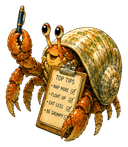
Pinchy’s Logbook Card
Hermit crab · keeps the clipboard
Pinchy has carried a clipboard for as long as anyone can remember, and he would like to explain why. If you do not write it down, you did not see it. You only think you saw it, and thinking is how arguments start.
His advice for any young scientist is short. Write the date. Write what happened, not what you hoped would happen. Draw it, even badly. And when you move a rock to look underneath, put it back. Somebody probably lives there, and they did not ask for visitors.
What goes wrong with marine biology gifts
A kit that does the science for them
Step-by-step kits with one right answer feel like science but leave nothing to discover.
Open-ended tools, like a lens, a notebook or a microscope, give a curious child questions for months.
A fish tank as a surprise
A live animal needs a set-up tank, a plan and a family that has agreed to it. A surprise tank often ends badly for the fish.
If a tank is the dream, give a book about keeping fish and plan the tank together in January.
Bringing animals home from the beach
Crabs, snails and starfish taken from a tide pool rarely survive a bucket or a home tank.
Teach the field rule instead: look, photograph, write it down, put it back.
Buying for the career, not the child
A university textbook or a pricey diving gadget is for an adult's idea of the future.
An 8-year-old wants to watch animals today. Feed that, and the career looks after itself.
Ordering printed books too late
Our books are printed to order, then shipped, which takes about 8 to 15 business days.
Order by 12 November for Hanukkah and by 3 December for Christmas, and earlier outside the US.
Questions we get asked
What should I get a kid who wants to be a marine biologist?
Give them the tools of the job, which are cheap: a 10× hand lens, a waterproof notebook and the free Seek by iNaturalist app. Add an outing to an aquarium, a tide pool or a pond, and a book about a real scientist, such as Shark Lady by Jess Keating.
What do marine biologists use every day?
Mostly notebooks, cameras, measuring tools and water test kits, plus computers to record and analyse what they find. Field days add nets, buckets and snorkels, and labs add microscopes. The habit underneath all of it is careful observation, written down with the date and place.
What subjects should a future marine biologist study?
Biology, chemistry and maths matter most, and writing does too, because every discovery has to be written up so other people can check it. NOAA Fisheries also advises students to keep their options open rather than specialising too early, so broad science is a good start.
Do you have to live near the ocean to become a marine biologist?
No. Many marine and fish biologists work in labs, public aquariums, fish farms and universities far from the coast, and freshwater biology uses the same skills. A child inland can start with a pond, a creek, a local aquarium or a home fish tank.
Is a science kit a good gift for a future scientist?
It can be, if it is open-ended. Kits that follow fixed steps to one result are fun once. Tools a child can point at anything, like a microscope, a hand lens or a notebook, keep producing new questions, and asking questions is the real skill.
Is a fish tank a good gift for a child who loves the ocean?
Only as a planned family project, never as a surprise. A tank needs to run for weeks before fish go in, and someone has to look after it every day. A book about keeping fish now, and a tank planned together later, works better.
When should I order a book gift for Hanukkah or Christmas?
Our books are printed to order and take about 8 to 15 business days to arrive. For Hanukkah, which begins on 4 December 2026, order by 12 November. For Christmas, order by 3 December. Allow extra time for addresses outside the US.
What books are good for a child who wants to be a marine biologist?
Shark Lady by Jess Keating, for ages 4 to 8, tells the true story of shark scientist Eugenie Clark. For 7 to 10, Book 1 of our series has real water science under the jokes. Our gift-books guide lists more titles by age and reading level.
Sources
- [1] NOAA FisheriesNOAA Fisheries. Looking for a Career in Marine Life? Look at NOAA (education, backgrounds, and advice to keep options open). View source
- [2] Seek by iNaturalistiNaturalist. Seek by iNaturalist: free species-identification app for families; no account required, observations kept private. View source
- [3] Shark LadyKeating, J., illustrated by Álvarez Miguéns, M. (2017). Shark Lady: The True Story of How Eugenie Clark Became the Ocean's Most Fearless Scientist. Sourcebooks. Ages 4–8. View source
- [4] Hanukkah 2026My Jewish Learning. Hanukkah 2026 begins at sundown on Friday 4 December and ends Saturday 12 December. View source
- [5] ShippingYechiel's Fishery Farm shipping page: printed to order, 3–5 business days printing plus 5–10 transit. View source
About the author
Yechiel Kuperman
Marine Biologist & Aquaculture Mentor
Yechiel has kept fish since he was four — 49 years with tanks — and 30+ years running farms. He mentors fish farmers internationally.
He writes the Yechiel's Fishery Farm books, in which the biology is real and the fish have opinions.
Last checked: