Gift Books for a Child Who Loves Fish, by Age and Reading Level
By Yechiel Kuperman, marine biologist · 49 years keeping fish
Quick answer
Buy for the fish they love and for how they read today, not only for their age.
Listeners under 5 do well with an ocean board book or the rhymes of Commotion in the Ocean, new readers with a National Geographic Kids reader such as Sharks, and a wordless book like Flotsam suits every level.
Confident readers of 9 and up can take graphic nonfiction such as Science Comics: Coral Reefs.
The numbers
| Book | Ages | Who it suits |
|---|---|---|
| Hello, World! Ocean Life by Jill McDonald | 0–3 | Listeners. A board book of real ocean animals, with a prompt to count the octopus's eight arms |
| Swim, Fish! Explore the Coral Reef by Susan B. Neuman (National Geographic Kids Readers, Pre-Reader) | 2–5 | A first book to read alone. Real photographs of whale sharks, seahorses and reef fish, in sight words |
| Barnacle Is Bored by Jonathan Fenske | 3–5 | Read-aloud comedy. A barnacle under a pier envies a colourful fish, right up until the fish meets an eel |
| Commotion in the Ocean by Giles Andreae, illustrated by David Wojtowycz | 3–7 | Listeners who like rhyme. Short poems about sea animals, with creatures hidden on every page |
| Flotsam by David Wiesner | 5–8 | Every reading level, because it has no words. The 2007 Caldecott Medal winner: a camera washes up full of impossible undersea photos |
| Sharks by Anne Schreiber (National Geographic Kids Readers, Level 2) | 5–8 | Newly independent readers who want facts rather than a story |
| The Brilliant Deep by Kate Messner, illustrated by Matthew Forsythe | 5–8 | Read-aloud true story of Ken Nedimyer, who started growing coral to replant damaged reefs |
| Fish Everywhere by Britta Teckentrup | 6–9 | Growing readers. A large nonfiction picture book on fish evolution, habitats, food and survival |
| The Water Has Opinions by Yechiel Kuperman (Book 1 of this site's series) | 7–10 | Ours, so weigh it yourself. A funny chapter book with real water science. A coloring companion and a book-plus-coloring package exist |
| Science Comics: Coral Reefs: Cities of the Ocean by Maris Wicks | 9–13 | Confident readers. Graphic nonfiction narrated by a goby, with real reef biology between the jokes |
Do this — step by step
- Ask which fish they love most, then buy for that fish.Sharks, reef fish, the guppy at a friend's house
- Match the book to how they read today, not to the age on the label.
- For a listener, pick a book you can stand to read aloud twenty times.
- For a new reader, pick one they can finish alone in a single sitting.Finishing is the reward
- For a confident reader, try graphic nonfiction or a chapter book with real science.
- Pair one story with one true book, and wrap them together.
- Add something to do: a coloring book, an aquarium trip, a fish to look up.
- Write the date and one line inside the cover.Inscribed books tend to be kept
What does a child who loves fish actually love?
Ask, because "fish" covers more ground than any other group of backboned animals. Eschmeyer's Catalog of Fishes, kept by the California Academy of Sciences, listed 37,772 valid species in September 2026. That is more than all the mammals, birds, reptiles and amphibians put together.
About half of them, 19,358 in the same count, live in fresh water. The other half live in the sea, from tide pools to the deep. A child who loves sharks and a child who loves the guppies in a tank are interested in very different animals, and the gift should know which child it is going to.
Some favourites come with facts worth checking before you buy. A seahorse father carries the eggs in a pouch and gives birth. A shark keeps growing new teeth all its life, in rows that move forward like a conveyor belt. A betta or gourami breathes air from the surface through a labyrinth organ.
Every fish shares one sense that people lack. The lateral line is a row of pores along the side of the body, lined with tiny hair cells, that feels the movement of water around it. A fish can sense a neighbour swimming past in the dark, which is how a school turns as one.
A good fish book gets these things right, and a child who knows them will spot a book that does not. That makes accuracy part of the gift. The quick bookshop test for a nature book works on fish books too.
Owning the book matters as well. In a 2016 National Literacy Trust survey of 42,406 children aged 8 to 18, those who said they owned a book were 15 times more likely to read above the level expected for their age: 28.8% against 1.9%.
That is a correlation. Homes with books differ from homes without them in plenty of ways, and a single gift will not rewrite a child's reading. But a book that is theirs, about the animal they love, is about the easiest start there is.
Reading level matters more than age. A 7-year-old who reads fluently and a 7-year-old who still needs every page read aloud want different books about the same fish, which is why the table sorts by both.
By the way, out in the ocean…
Manta ray. It glides on wing-like fins up to seven metres across — a giant so gentle it eats only tiny drifting plankton. A child who names the manta ray before the goldfish wants a reef book. Buy for the animal they name first.
Seahorse. The fish that swims standing up — and among seahorses, it is the dads that carry the babies. If a gift book includes seahorses, check that the father carries the young. It is a fast test of whether the author did the reading.
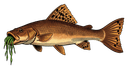
Plecy’s Logbook Card
Plecostomus · glutton, reformed, mostly
Plecy has strong views on gifts, because he has received the wrong one many times. Fish flakes, floating at the top of the tank, where he does not go. A plecostomus eats from the bottom and the glass. A flake is a present for somebody else.
So he checks what the other fish like before anyone buys anything. The guppies want flakes. He wants a sinking wafer and a bit of courgette. A child who loves sharks wants sharks. Give a gift that fits the one who gets it, he says, and then give him the courgette.
What goes wrong with fish gift books
Buying by the age on the label alone
Age bands on books are publisher estimates, and they assume an average reader. Plenty of 8-year-olds still want every page read to them, and plenty of 6-year-olds read far ahead.
Ask the parent how the child reads now. Then pick from the table by that row, not by the birthday.
Giving the book you loved as a child
Nostalgia is a lovely reason to buy a book and a poor way to choose one. Older fish books often carry the goldfish bowl, the fish with a smile and a tank with no filter.
If you must give an old favourite, give it with a newer true book about the same fish.
Wrapping a live fish with the book
A fish is a pet with years of care ahead of it, and a surprise one usually starts in the wrong tank. That is a decision for the family, made first.
Give the book, and let the book start the conversation about a tank.
Forgetting the grown-up who reads it aloud
Under 6, a gift book is a gift to the adult who reads it at bedtime, over and over. Rhyme that scans and jokes that land on the twentieth reading matter.
Read two pages in the shop, out loud if you can bear it. If you are bored by page two, so will they be by Friday.
Questions we get asked
What is a good gift for a child who loves fish?
A book about the fish they love most, matched to how they read today. Board books such as Hello, World! Ocean Life suit toddlers, National Geographic Kids readers suit new readers, and Science Comics: Coral Reefs suits confident readers of 9 and up. Add a coloring book or an aquarium trip.
What fish book should I buy for a 5-year-old?
If they are still being read to, Commotion in the Ocean or The Brilliant Deep. If they are starting to read, a Level 2 reader like National Geographic Kids Sharks. Flotsam by David Wiesner has no words at all, so it works for any 5-year-old, whatever their reading.
What is a good fish book for a 9 or 10-year-old?
Science Comics: Coral Reefs: Cities of the Ocean by Maris Wicks is graphic nonfiction listed for ages 9 to 13. For a child who prefers stories, try a funny chapter book with real science in it, such as the George the Cranky Guppy series from this site.
Should I give a fish tank as a present?
Only if the family has already decided on it. A fish needs a cycled, filtered tank and years of care, and a surprise usually starts in a bowl. Give a book first and let the child research the fish. Our guide on fish as a first pet covers the decision honestly.
Are wordless picture books a good gift?
Yes, especially when you do not know how well the child reads. A wordless book like Flotsam, the 2007 Caldecott Medal winner, puts every reader on equal terms. Children tell the story themselves, which means they talk about it, and older siblings often pick it up too.
Does owning books really help children read?
It is linked. A National Literacy Trust survey of over 42,000 children aged 8 to 18 found book owners 15 times more likely to read above the expected level. That is a correlation, not proof, but a book about a loved animal is an easy place to start.
Which George the Cranky Guppy book should I give first?
Start with Book 1, The Water Has Opinions. The books are funny chapter books for ages 7 to 10 by marine biologist Yechiel Kuperman, and each builds on the last. A coloring companion suits a younger sibling, and a book-plus-coloring package is on the books page.
Sources
- CAS 2026Fricke, R., Eschmeyer, W. N. & Van der Laan, R. (eds). Eschmeyer's Catalog of Fishes: Genera, Species, References. California Academy of Sciences, version of 21 September 2026. View sourceNote: The count changes monthly as new species are described and old names are merged.
- NLT 2016National Literacy Trust. Book ownership and reading outcomes. Findings from the annual literacy survey of 42,406 children and young people aged 8 to 18, Nov–Dec 2016. View sourceNote: Correlational. Book ownership tracks many other advantages, so it does not show that a gift alone raises attainment.
- ALA FlotsamAmerican Library Association. Flotsam by David Wiesner, 2007 Randolph Caldecott Medal. View source
About the author
Yechiel Kuperman
Marine Biologist & Aquaculture Mentor
Yechiel has kept fish since he was four — 49 years with tanks — and 30+ years running farms. He mentors fish farmers internationally.
He writes the Yechiel's Fishery Farm books, in which the biology is real and the fish have opinions.
Last checked: