Are Picture Books Still OK for Older Kids?
By Yechiel Kuperman, marine biologist · 49 years keeping fish
Quick answer
Yes. Picture books are fine at 8, 9, 10 and beyond, and many of the best are written for older readers.
Their text often holds richer vocabulary and harder sentences than everyday talk, and the Caldecott Medal counts children up to 14 as its audience.
Keep picture books alongside chapter books rather than instead of them, and only worry if a child avoids every book with more words than pictures.
The numbers
| Book | Ages | Why an older child gets more from it |
|---|---|---|
| Giant Squid by Candace Fleming, illustrated by Eric Rohmann | 6–10 | A 2017 Sibert Honor Book. An animal known mostly from clues, so the book is about how scientists know what they cannot see |
| The Boy Who Harnessed the Wind (picture book edition) by William Kamkwamba and Bryan Mealer, illustrated by Elizabeth Zunon | 6–8 | The true story of a boy in Malawi who built a windmill from scrap during a drought. Engineering and drought in 32 pages |
| Grand Canyon by Jason Chin | 7–12 | A 2018 Caldecott Honor and Sibert Honor Book. A father and daughter hike down through rock layers and millions of years, with a gatefold |
| Shackleton's Journey by William Grill | 7–11 | Winner of the 2015 Kate Greenaway Medal. The Endurance expedition in coloured pencil, with diagrams of the dogs, supplies and gear |
| The Wall: Growing Up Behind the Iron Curtain by Peter Sís | 8–12 | Winner of the 2008 Sibert Medal and a Caldecott Honor. An illustrated memoir of growing up in communist Czechoslovakia |
| The Invention of Hugo Cabret by Brian Selznick | 9–12 | Over 500 pages, 284 of them drawings. It won the 2008 Caldecott Medal, the top American picture-book prize |
| The Arrival by Shaun Tan | 12+ | A wordless graphic novel about arriving in a strange country. No words, and still one of the hardest books on this list |
Do this — step by step
- Keep picture books on the shelf next to the chapter books instead of clearing them out at 7.
- Look for picture books written for older readers: science, history, memoir, exploration.Check the age band on the back
- Keep reading aloud after they can read alone, and let picture books be part of it.
- Ask what the pictures show that the words leave out.That is a real reading skill
- Let a tired or struggling reader alternate: a picture book, then a chapter.
- Open a big topic with a picture book, then follow it with a longer book.
- Never call a book babyish, in front of them or a younger sibling.
Do picture books still teach an older child anything?
More than most parents expect. The words in a good picture book are often harder than the words around it at home.
In 2015, Jessica Montag, Michael Jones and Linda Smith compared the text of 100 popular picture books with recordings of parents talking to their children. The books contained more unique words than the conversation. Individual books usually beat a conversation of the same length.
A 2019 follow-up by Montag looked at grammar. Picture books contained more of the rare, complex sentence types, passive sentences and sentences with relative clauses, than everyday speech to children. A book written to be read aloud can afford a sentence that nobody would say over breakfast.
Most of that research looks at young children. The point carries up the age range because the best picture books for older readers are written at their level. Grand Canyon explains how rock layers record time. The Wall deals with censorship and fear. Neither was written for a four-year-old.
The prize committees agree. The Caldecott Medal defines children as anyone up to and including 14, and says picture books for that whole range count. In 2008 it went to The Invention of Hugo Cabret, a novel of over 500 pages in which 284 pages are pictures.
Reading the pictures is a skill in its own right. A picture can contradict the text, add a joke the words never mention, or carry the whole story, as in The Arrival. Working out what an image is saying is part of reading a diagram, a map or a science textbook later on.
What does drop at this age is being read to. In Scholastic's 2019 Kids & Family Reading Report, 45% of 6 to 8-year-olds were read aloud to at home five to seven days a week. For 9 to 11-year-olds it was 21%. Parents most often said the reason was that the child could read on their own.
Picture books are an easy way to keep that time going, because a whole book fits in one evening. For a child who finds reading hard, they are also a way to finish a book, often, which is what keeps a reader reading.
The George the Cranky Guppy books, by this site's author, sit between the two shelves on purpose. They are illustrated chapter books for ages 7 to 10 with short chapters, so a child can move up without leaving pictures behind.
By the way, out in the ocean…
Axolotl. The internet's favourite smiling amphibian can regrow a whole lost leg — yet in the wild it is critically endangered. Axolotls keep their juvenile gills all their lives and do just fine. Keeping picture books a little longer is the same kind of normal.
Jellyfish. Drifting through the sea with no brain and no heart — and some kinds glow with their own light. A glowing jellyfish on a page amazes a 4-year-old. A 10-year-old asks how the light is made, which is why good picture books age well.
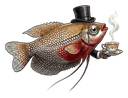
Sir Bubbleton’s Logbook Card
Gourami · a gentleman of mature years
Sir Bubbleton is a fish of mature years and settled habits, and he reads picture books. He has no intention of apologising for it. A good picture, he says, is a sentence you read with your eyes, and some of them take a very long time to finish.
He has noticed that the young fish who read only the words miss half the joke. The picture of the tank shows the heater unplugged. The text says everything is fine. He considers spotting that sort of thing a sign of a well-read fish, whatever its age.
What goes wrong when parents retire picture books
Clearing the picture books out at 7
The first chapter book feels like a graduation, and the picture books go in a box for a cousin. The child loses a whole shelf of books they can finish in one sitting.
Keep the best ones, and add picture books written for older readers alongside the chapter books.
Calling a book babyish
Children hear it even when it is said to someone else. A child who is struggling with longer books will quietly stop picking up the ones they can actually read.
Talk about books by subject instead: the squid book, the canyon book, the book about the wall.
Treating pictures as a crutch
For a child with dyslexia or a slow decoding speed, pictures carry meaning while the words catch up. That is support, the same way a diagram supports a science text.
Keep the pictures and work on the reading as well. Taking the pictures away only makes each page cost more.
Stopping read-aloud because they can read
This is the most common reason families give for stopping, and it drops the child just as the books get harder. Listening comprehension runs ahead of reading for years.
Ten minutes, three evenings a week, with a picture book they chose, keeps the habit alive.
Buying only picture-book stories
Many older children prefer nonfiction picture books to picture-book stories. Giant Squid, Grand Canyon and Shackleton's Journey treat an 8-year-old as a serious reader.
If the story books are gathering dust, try the true ones before deciding picture books are over.
Questions we get asked
Are picture books OK for 8-year-olds?
Yes. Many picture books are written for 8 to 12-year-olds, and their text often has richer vocabulary than everyday talk. Keep them alongside chapter books. Grand Canyon, Shackleton's Journey and The Wall are all listed for ages 7 or 8 and up by their publishers.
At what age do kids stop reading picture books?
There is no fixed age, and there does not need to be. Most children add chapter books between 6 and 8, but picture books keep their value well beyond that. The Caldecott Medal, America's top picture-book prize, defines its audience as children up to and including 14.
Is it bad if my 9-year-old only reads picture books?
Not in itself. It is worth a closer look if they avoid every book with more words than pictures, or if reading seems tiring. That can signal a decoding difficulty such as dyslexia. Talk to their teacher, and keep offering picture books while you find out.
What are good picture books for older kids?
Try nonfiction and history written for older readers: Giant Squid by Candace Fleming, Grand Canyon by Jason Chin, Shackleton's Journey by William Grill and The Wall by Peter Sís. For 9 and up, The Invention of Hugo Cabret. From 12, Shaun Tan's wordless The Arrival.
Do picture books help dyslexic or reluctant readers?
Often, yes. Pictures carry part of the meaning, pages are short, and a whole book can be finished in one sitting, which builds the habit. Pair them with books designed for easier reading, with good spacing and short chapters, rather than taking the pictures away.
Should I still read aloud to my 10-year-old?
Yes, if they will let you. Scholastic's 2019 survey found read-aloud falls from 45% of 6 to 8-year-olds to 21% of 9 to 11-year-olds, usually because the child can read alone. Listening lets them enjoy books harder than they can read yet.
Are graphic novels the same as picture books?
They are close relatives. Graphic novels tell the story in panels, usually with speech bubbles, while picture books pair a page of art with a block of text. Both ask a child to read pictures and words together, and both count as real reading. The Arrival sits right on the line.
Are the George the Cranky Guppy books picture books?
No. They are illustrated chapter books for ages 7 to 10 by marine biologist Yechiel Kuperman, with short chapters. They suit a child moving up from picture books who still likes a picture on the page, and the fish science in them is real.
Sources
- Montag 2015Montag, J. L., Jones, M. N. & Smith, L. B. (2015). The words children hear: Picture books and the statistics for language learning. Psychological Science 26(9), 1489–1496. View sourceNote: Compares picture-book text with speech to young children. The older-reader point is an inference, stated as one.
- Montag 2019Montag, J. L. (2019). Differences in sentence complexity in the text of children's picture books and child-directed speech. First Language 39(5), 527–546. View source
- KFRR 2019Scholastic (2019). Kids & Family Reading Report, 7th edition: The Rise of Read-Aloud. Survey fielded by YouGov, September–October 2018, 2,758 parents and children. View source
- ALA CaldecottAssociation for Library Service to Children, American Library Association. Randolph Caldecott Medal: terms and criteria (children defined as persons up to and including age 14). View source
About the author
Yechiel Kuperman
Marine Biologist & Aquaculture Mentor
Yechiel has kept fish since he was four — 49 years with tanks — and 30+ years running farms. He mentors fish farmers internationally.
He writes the Yechiel's Fishery Farm books, in which the biology is real and the fish have opinions.
Last checked: