What to Do With a Classroom Fish Tank Over the Holidays
By Yechiel Kuperman, marine biologist · 49 years keeping fish
Quick answer
Healthy adult fish sail through a long weekend of two or three days with no food at all — the dangerous move is the extra-large feed before you leave, which rots in the tank while nobody is watching.
For a one- or two-week break, use an automatic feeder you have tested for a full week beforehand, or leave a helper pre-portioned doses rather than a tub and good intentions.
For the summer, plan properly: move the tank to a home, hand it to an experienced keeper, or wind it down — and whatever happens, keep the filter media wet.
Download the printable pack
A four-page PDF: the classroom pack cover, the reading badges, and the Mosquito Patrol and Real Scientists Ask Questions posters. The badges suit a holiday reading challenge. The reading quizzes for Books 1–3 are separate free PDFs on the Educators page.
Classroom Pack: cover, reading badges and two postersPDFThe numbers
| What | Metric | US | Why it matters over a break |
|---|---|---|---|
| Healthy adult fish, no food at all | 2–3 days, routinely | 2–3 days, routinely | A long weekend needs no plan beyond a normal last meal |
| Hardy adults in a clean, understocked tank | up to 7 days | up to 7 days | Uncomfortable to read, true in practice — food is not the weak point |
| Fry and very young fish, unfed | 1 day | 1 day | Growing fish are the real exception; they need daily human cover |
| Automatic feeder test run | 7 days before the break | 7 days before the break | Loaded with the classroom's actual food, running over the actual tank |
| Light on a plug-in timer | 6–8 hours a day | 6–8 hours a day | Algae does not take holidays |
| Tropical tank temperature, heater on | 24–26 °C | 75–79 °F | The empty-building risk is cold, not hunger |
| Water change before leaving | about 25 % | about 25 % | The day before you go, so you can watch the tank settle afterwards |
| Last filter clean before the break | 7 days before you leave | 7 days before you leave | Never the day before — give the colony time to resettle |
Do this — step by step
- Feed a normal last meal on the last day — never a double one to hold them over.the goodbye mega-feed is the killer, not the fast
- Clean the filter a week before the break, in a bucket of tank water — never the day before.
- Change about a quarter of the water the day before you leave, and top the tank up to the line.
- Put the light on a plug-in timer set to 6–8 hours a day.algae does not take holidays
- Leave the heater on, and find out what the building does to its heating over the break.
- For one to two weeks away, run an automatic feeder you have already tested for a full week.on your actual food, over your actual tank
- If a human is covering instead, hand them pre-portioned doses — a pill organizer or labeled bags, never a pinch.an untrained pinch is about five meals
- Tape a one-page card to the glass: doses, dates, your phone number, and what a healthy tank looks like.
- Ask whoever checks in to count the fish, watch them move, and glance at the water and the thermometer.
Why can a fish skip a week of meals when a hamster cannot?
A fish is an ectotherm — cold-blooded. It does not burn food to keep its body warm, which is where a mammal spends most of its energy budget. Take a hamster's food away and it is in trouble within a day; a fish at classroom temperature simply idles.
Wild fish are built for exactly this. Food in a river arrives in pulses — an insect hatch, a good afternoon, then nothing — so fish bank energy in the liver and body tissue and draw it down smoothly between meals.
That is why a healthy adult fish treats a two- or three-day weekend as a non-event, and why a hardy adult in clean water manages a week. Activity drops, metabolism slows, and the reserves cover the gap.
The real danger over a break is the opposite mistake. Food no fish eats does not disappear — it decomposes, and decomposition produces ammonia, the same toxin the filter spent six weeks learning to remove.
An extra-large goodbye feed is therefore a slow-release ammonia dose in a room where nobody will read the water for a fortnight. The fast was survivable; the kindness is what poisons the tank.
Temperature is the second quiet risk, and the bigger one in winter. A fish's immune system slows badly in the cold, and many school buildings set the heating right down the moment the doors lock.
The heater's job over a break is to hold the line while the room around it drops — which is why it must be sized for the coldest week of the year, and why it stays on even though the room is empty.
It is also why the checker's glance at the thermometer matters more than the food. A tank that has gone cold holds fish in real trouble; a tank that has merely missed four meals holds fish that are bored.
The filter, meanwhile, is the one resident that must never go without. Its bacteria live on the wet media, and they ride out a quiet fortnight of reduced waste without drama — the colony downsizes a little and regrows.
What the colony cannot survive is drying out. If a tank is ever moved or wound down, the water is replaceable; the wet sponge is six weeks of grown biology. Keep it submerged in tank water and it travels.
Fry are the honest exception to all of this. Very young fish carry almost no reserves and are growing fast, so they genuinely need feeding every day. A tank with babies in it needs a trained human, not a gadget.
Put together, the holiday problem is not really 'who feeds the fish'. It is 'who keeps the water warm, the filter wet and the food out' — and that reframing is what the checklist above is built on.
By the way, out in the ocean…
Sea turtle. Ancient mariners — their kind has crossed the oceans for over 100 million years, migrating thousands of kilometres. Sea turtles cross entire oceans between proper meals — your fish only have to manage a school break.
Axolotl. The internet's favourite smiling amphibian can regrow a whole lost leg — yet in the wild it is critically endangered. Keepers of rare axolotls arrange holiday cover the same way you are about to — in writing, before anyone leaves.
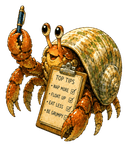
Pinchy’s Logbook Card
Hermit crab · property inspector, reluctantly
Pinchy has inspected this property ahead of the holidays, and for once he has good news, delivered nervously. The residents can miss a few meals. He has checked twice. They will be fine. He would like that in writing.
What will not be fine: a mountain of food dumped in on the last day. He has seen what a week of rotting flakes does to a building. He files it under structural damage, and he underlines it.
His conditions for sign-off: heater on, light on a timer, instructions taped to the glass, and one named human with a key. Then — and only then — he stamps the form and retreats into his shell until term starts.
How classroom tanks are actually lost over a break
The goodbye mega-feed
It feels like care: one big scoop so they will not go hungry. But fish stop eating when they are full, and everything else sinks and rots. Ammonia climbs for days in a locked, unwatched room.
Feed a boring, normal meal and leave. A healthy adult fish is far safer slightly hungry than swimming in the leftovers of your generosity.
The feeder that was never tested
Automatic feeders fail in two directions: they jam and feed nothing, or the food clumps with moisture and the hopper dumps at once. Both failures look identical in the box on the shelf.
A full test week before the break — real food, real tank, portions watched — catches nearly all of it. An untested feeder is a promise, not a plan.
The heater alone in a cold building
Schools set the heating down over winter break, and a heater that coped in term time can lose the fight against an empty, unheated room — slowly, over days, with nobody watching.
Check the heater's rating against the tank, ask what the building does over the break, and make the thermometer the checker's first glance. It is the single most useful one.
The helpful somebody who unplugged it
A cleaner or caretaker hears a humming box in an empty classroom and switches it off to be safe. The filter bacteria begin dying within hours of the flow stopping.
Label the plugs — 'aquarium life support, please do not unplug' — and say it in person to whoever holds a key over the break. This failure is entirely a communication problem.
The panic water change on return
The tank looks a little green in January, so somebody drains most of it and refills from the tap. The sudden swing in temperature and chemistry shocks fish that had quietly coped with everything else.
Come back, feed lightly, test the water, and do your normal quarter change. The tank survived the break; do not make the reunion the disaster.
Questions we get asked
How long can classroom fish go without food?
Healthy adult fish handle two or three days with no harm at all, and hardy adults in a clean, understocked tank manage up to a week.
Fry and very young fish are the exception — they need feeding every day, so a tank with babies in it needs a trained human, not a feeder.
Should I use a vacation feeder block?
Only as a last resort. The blocks dissolve on their own schedule, not the fish's, and the binder can foul the water in a small tank while you are away.
For a weekend you need nothing at all. For a week or two, a tested automatic feeder or a helper with pre-portioned doses beats a block on both safety and mess.
Are automatic fish feeders reliable enough for two weeks?
Good ones are — once proven. Run the feeder for a full week before the break, mounted over the tank, loaded with the food you actually use, and watch the portions it drops.
Its two failure modes, jamming and moisture-clumped dumping, both show up during a test week and are both invisible in the shop.
Who should feed the fish over the break, and how much?
One named adult with a key, given pre-portioned doses in a pill organizer or labeled bags, feeding every second or third day.
Never say 'a pinch'. An untrained adult's pinch is roughly five meals, and overfeeding an unwatched tank is the most common way a break goes wrong.
Can I take the classroom fish tank home for the summer?
Yes, and for a six-week break it is usually the right call. Bag the fish, carry them in an insulated box, and keep the filter media submerged in tank water the whole way.
Move the tank itself drained — a full tank cracks — and carry a good share of the old water in sealed buckets to refill with, so the chemistry stays familiar.
Should the heater and lights stay on over the holidays?
Heater on, always — cold in an empty building is a bigger threat than hunger, especially over winter break. Lights go on a plug-in timer at six to eight hours a day.
Leaving the light on around the clock does nothing for the fish and grows a wall of algae to greet you in January.
What should the person checking the tank look for?
Four glances, one minute: every fish present and moving, water clear rather than milky or green, the thermometer in range, and the filter outlet rippling.
Anything off gets a phone call to you, not an improvised fix. The card taped to the glass should say exactly that, with your number on it.
Do I need a big water change when we get back?
No — that instinct causes the second crash. Test the water first, feed a light meal, and do your normal quarter change.
If nitrate has drifted high over the break, bring it down over several days with repeated small changes rather than one dramatic one.
Sources
- McCue 2010McCue, M. D. (2010). Starvation physiology: Reviewing the different strategies animals use to survive a common challenge. Comparative Biochemistry and Physiology Part A 156(1), 1–18. View sourceNote: A cross-species review, not an aquarium study. It supports the mechanism — ectotherms ride out fasts on stored reserves — and none of this page's specific day counts, which are standard husbandry practice.
- NSTA 2005National Science Teachers Association (2005). Responsible Use of Live Animals and Dissection in the Science Classroom. NSTA Position Statement. ERIC ED489293. View sourceNote: Archived rather than current — it no longer appears among NSTA's listed official positions. It remains the published guidance that asks teachers to plan animal care across school breaks.
About the author

Yechiel Kuperman
Marine Biologist & Aquaculture Mentor
Yechiel has kept fish since he was four — 49 years with tanks — and 30+ years running farms. He mentors fish farmers internationally.
He writes the Yechiel's Fishery Farm books, in which the biology is real and the fish have opinions.
Last checked: