The Right Aquarium Temperature (and Why Steady Beats Exact)
By Yechiel Kuperman, marine biologist · 49 years keeping fish
Quick answer
Most tropical fish do well anywhere between 24 and 28 °C (75–82 °F), and goldfish prefer a cooler 18–22 °C (64–72 °F).
The exact number matters less than keeping it steady: a fish at a constant 24 °C is healthier than one bouncing between 24 and 28.
Buy a separate thermometer, place it away from the heater, and change the temperature by no more than about 1 °C per day.
The numbers
| Fish type | Temperature (°C) | Temperature (°F) | What to know |
|---|---|---|---|
| Tropical community tank | 24–28 °C | 75–82 °F | Any steady point in this band beats a wandering one |
| Goldfish and other coldwater fish | 18–22 °C | 64–72 °F | A tropical setting is too warm for them long-term |
| Betta | 25–27 °C | 77–81 °F | The warm end — bettas go listless in cool water |
| Quarantine / hospital tank | 26–28 °C | 79–82 °F | Often run slightly warmer; raise it slowly, never in one jump |
Do this — step by step
- Buy a real thermometer — a separate glass or digital one, not the dial printed on the heater.Heater dials drift; the thermometer is the truth
- Place the thermometer at the opposite end of the tank from the heater.Next to the heater it reads the heater, not the tank
- Size the heater at roughly 1 watt per litre — about 3 to 5 watts per US gallon.A 60 L tank wants roughly 50–75 W
- Set the heater once, then check the thermometer at the same time every day.Same time daily makes a slow drift visible
- If you must adjust, move the setting no more than about 1 °C (2 °F) per day.Fish adapt to slow change, not sudden change
- Match new water to tank temperature before every water change — never top up cold.Check the bucket with the same thermometer
- Unplug the heater before a water change and wait ten minutes before draining.A hot heater exposed to air can crack
- Keep the tank away from windows, radiators, and air-conditioning vents.Sunlight and room heat swing a small tank fast
Why can't fish just cope with the wrong temperature?
Fish are ectotherms. They cannot make their own body heat, so a fish's body temperature is the temperature of the water around it. When the tank changes, the fish changes with it, whether its body is ready or not.
Everything inside a fish runs on enzymes, and enzymes are speed-sensitive to temperature. Warm the water and digestion, breathing, and heartbeat all speed up. Cool it and they all slow down. There is a band where everything works well; outside it, things start to fail quietly.
The immune system fails first. A fish held too cold, or too hot, fights off bacteria and parasites poorly. It looks fine for days or weeks, eating a little less, moving a little less. Then an infection a healthy fish would shrug off takes hold.
Warm water carries its own trap: as water heats up, it holds less dissolved oxygen. Meanwhile the warmer fish needs more oxygen, because its body is running faster. More demand, less supply. That is why an overheated tank shows fish gasping at the surface.
Now the heart of the matter. A steady temperature that sits a degree or two off the textbook number is a mild, manageable strain. A sudden swing is not. A fish's body can adjust to slow change over days; it cannot adjust in minutes.
A rapid change is called temperature shock. Enzymes, gill function, and the nervous system are suddenly running at the wrong speed all at once. Shocked fish go pale, clamp their fins, sit on the bottom, or dart wildly. Some die within hours; survivors are left weakened.
This is why a cold top-up during a water change is more dangerous than a heater set slightly wrong. The wrong-but-steady tank strains a fish gently. The bucket of cold tap water hits every system in its body at the same moment.
So do not chase 26 °C exactly. Pick a sensible number inside your fish's range, then defend it. Steady beats exact, every time.
By the way, out in the ocean…
Blue whale. The largest animal that has ever lived — bigger than any dinosaur — and it grows that big on a diet of tiny krill. A blue whale burns fuel to hold its body at about 37 °C in freezing seas; a fish's body is simply whatever temperature its water is.
Seahorse. The fish that swims standing up — and among seahorses, it is the dads that carry the babies. Seahorses are so sensitive to temperature swings that public aquariums hold their tanks steady to within a fraction of a degree.
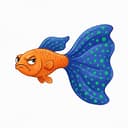
Empress Matilda’s Logbook Card
Elder of the Old Lake · Dor 70
In seventy years I have survived three pump failures, two droughts, one flood, and a summer when somebody thought it would be helpful to put ice cubes in my lake. It was not helpful.
The lake warmed slowly and cooled slowly, and so did I. That is how I outlived them all. A fish does not mind a warm June or a cool November; a fish minds surprises.
So: one reliable heater, one honest thermometer, and no sudden acts of kindness. If you must change my water, change it the way a season changes: gradually, politely, with notice. Do that, dear, and your fish may yet grow as old and as magnificent as I am.
What goes wrong when people try to help
Trusting the heater's dial with no thermometer to check it
The number printed on a heater dial is a promise, not a measurement, and cheap thermostats drift by a few degrees in either direction.
A tank can sit at 30 °C for weeks while the dial swears it is holding 26, and the first visible sign is fish gasping at the surface.
A thermometer costs less than a single fish. Put one at the far end of the tank and glance at it daily; that one habit catches a drifting heater, a stuck-on heater, and a dead heater alike.
Topping up with cold tap water straight into the tank
This is the classic 'my fish died after a water change' story. The tank sat at a steady 26 °C; the bucket came in at 15.
In a small tank, a big cold top-up can drop the temperature several degrees in under a minute — a swing the fish would never meet in nature and cannot adjust to.
Fill the bucket, treat it with dechlorinator, and stand your thermometer in it. When bucket and tank read within a degree of each other, pour slowly. The extra ten minutes is the whole trick.
Moving the tank next to a window or a radiator
A sunny window can push a small tank up several degrees by afternoon, and the heater then lets it fall back every night — a daily swing dressed up as a nice spot for the fish.
Radiators and air-conditioning vents do the same in reverse, fighting the heater in cycles the thermostat can never quite win.
Pick a wall away from direct sun, heat sources, and drafts. A boring corner with a steady reading is a far better view for the fish than a bright windowsill.
Questions we get asked
What temperature should a fish tank be?
Most tropical community fish do well between 24 and 28 °C (75–82 °F).
Goldfish and other coldwater fish prefer roughly 18–22 °C (64–72 °F), and bettas like the warm end, around 25–27 °C.
Pick one number inside your fish's range and keep it steady; stability matters more than the exact figure.
Do fish tanks need a heater?
Tropical fish do, in almost every home. Room temperature drops at night and in winter, and a heater is what smooths that out.
Goldfish and white cloud minnows usually manage without one in a heated house.
Whatever you keep, the thermometer is not optional; it is how you know.
Can fish recover from temperature shock?
Sometimes, if the change was small and you act gently. Return the temperature to the fish's normal range slowly, keep the lights dim, and do not feed for a day.
Fish that were shocked badly may recover their balance yet die of infection later, because shock suppresses the immune system for weeks.
Why did my fish die after a water change?
The usual culprit is temperature: new water straight from a cold tap can drop the tank several degrees in a minute, which is textbook temperature shock.
Untreated chlorine is the other common cause.
Match new water to the tank by touch and thermometer, and always add a dechlorinator first.
What size heater do I need for my aquarium?
A useful rule of thumb is about 1 watt per litre, which works out near 3–5 watts per US gallon.
A 60-litre tank wants roughly a 50–75 watt heater.
In a cold room, or a tank much bigger than 200 litres, two smaller heaters beat one large one.
Can goldfish live in a tropical tank?
It is not a good match. Goldfish prefer roughly 18–22 °C, and a steady 26 °C tropical tank keeps their bodies running too fast for comfort, year after year.
They also grow large and produce a lot of waste.
Keep goldfish with goldfish, in cool water, with room to grow.
What happens if my aquarium heater fails?
A stuck-off heater cools the tank slowly toward room temperature, which most fish tolerate for a day; wrap the tank in towels and replace it.
A stuck-on heater is the emergency, because it can cook a tank overnight.
A daily glance at the thermometer catches both failures early.
Should I turn the aquarium heater off at night?
No. Fish do not want a cool night the way we do; they want the same water at 3 a.m. as at 3 p.m.
Modern heaters have thermostats and switch themselves off at the set point.
Turning the heater off at night creates exactly the daily swing you are trying to prevent.
Sources
- Merck Vet ManualFrancis-Floyd, R., Yanong, R. P. E. & Petty, B. D. Environmental Diseases of Aquatic Animals in Aquatic Systems. Merck Veterinary Manual. View source
- UF/IFAS CIR919Francis-Floyd, R. Stress—Its Role in Fish Disease. University of Florida IFAS Extension, Circular 919 (FA005). View source
Want the original printed guide?
Download the PDFAbout the author

Yechiel Kuperman
Marine Biologist & Aquaculture Mentor
Yechiel has kept fish since he was four — 49 years with tanks — and 30+ years running farms. He mentors fish farmers internationally.
He writes the Yechiel's Fishery Farm books, in which the biology is real and the fish have opinions.
Last checked: