Guppy Facts for Kids: What Makes Guppies So Special
By Yechiel Kuperman · 49 years with fish
Quick answer
Guppies are small, colourful freshwater fish from the streams of northern South America and islands like Trinidad.
They are livebearers, which means the babies grow inside the mother and are born already able to swim, often 30 to 60 at a time.
Only the males are brightly coloured, every male's pattern is different, and the fish is named after Robert Guppy, a man who sent some to a London museum in 1866.
The numbers
| Fact | Metric | US | What it means |
|---|---|---|---|
| Grown-up male | 1.5–4 cm | 0.6–1.6 in | About as long as a paperclip |
| Grown-up female | 3–7 cm | 1.2–2.8 in | Bigger than the males, and usually much plainer |
| Waiting for babies | about 3–4 weeks | about 3–4 weeks | In a warm tank. It takes longer in cooler water |
| Babies born at once | usually 30–60 | usually 30–60 | As few as 2, or as many as 200 |
| Warm water they like | 24–28 °C | 75–82 °F | Most homes are cooler, so pet guppies need a heater |
| How long they live | about 2 years | about 2 years | In the wild. Often 2 to 3 years in a well-kept tank |
| Named after Robert Guppy | 1866 | 1866 | He sent guppies from Trinidad to the museum in London |
Do this — step by step
- Find a tank with guppies: at home, at school or in a pet shop.
- Watch quietly for five minutes, and never tap the glass.Tapping frightens fish
- Count the small, colourful fish with big tails. Those are the males.
- Count the bigger, plainer fish. Those are the females.
- Look for orange spots on the males, and see which males the females follow.
- Check two males side by side and find one way their patterns differ.No two are the same
- Read the tank thermometer and write down the temperature.
- Draw your favourite guppy and colour in its pattern from memory.
What makes a guppy a guppy?
A guppy is a small freshwater fish. Freshwater means the water of rivers, streams and ponds, not the salty sea. Wild guppies live in streams in the north-east of South America and on nearby islands such as Trinidad.
Scientists call the guppy Poecilia reticulata. A German scientist, Wilhelm Peters, first described it in 1859. In 1866, fish sent from Trinidad by a man named Robert Guppy were named after him. Scientists later went back to Peters' name, but everyone kept calling the fish a guppy.
Most fish lay eggs. Guppies are livebearers: the babies grow inside the mother and are born able to swim. Baby fish are called fry. A mother guppy can have a new family about once a month, and she can keep having families for months after meeting a male.
That is why a tank with boy and girl guppies fills up so quickly, and why people sometimes call guppies millionfish. Many families keep only males, so the tank stays the right size for the fish in it.
Only the males wear the bright colours. Female guppies choose which male to swim with, and many choose males with bright orange spots. Bright colours help a male get chosen. They also make him easier for a predator, an animal that hunts other animals, to spot.
In the streams of Trinidad, scientist John Endler noticed something. Where there were lots of predator fish, male guppies were duller. Where there were few, males were brighter. When guppies were moved to safer pools, the males grew more colourful over a few years. That is evolution you can watch.
Guppies can also see ultraviolet light, a colour people cannot see at all. So part of a male's pattern may be brighter to a female guppy than it looks to us.
Guppies are clever for their size. In experiments, guppies learned which colour led to food, and some learned to switch when the rule changed.
Because guppies eat the wriggly young of mosquitoes, people let them go in rivers and ponds in many countries to fight mosquitoes. In lots of places the guppies harmed the fish that already lived there. So a pet guppy should never be let go outdoors.
By the way, out in the ocean…
Seahorse. The fish that swims standing up — and among seahorses, it is the dads that carry the babies. Guppy mums give birth to swimming babies. Seahorses skip the egg-laying too, but there it is the dads who carry the babies.
Octopus. One of the ocean's cleverest animals: eight arms, three hearts, and skin that changes colour to vanish in plain sight. An octopus changes colour in a blink. A male guppy keeps much the same pattern all his life, like a name tag the other guppies can read.
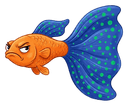
George the Cranky Guppy’s Logbook Card
Guppy · named after a man called Robert
George would like it known that he did not choose the name. A man called Robert Guppy sent some of his relatives to a museum in 1866, and the name stuck to every guppy since. Nobody asked the fish.
He has made his peace with it. Guppy is short, easy to shout across a tank and better than millionfish, which he thinks sounds like a lottery prize. He does insist that you look at his tail before you look at anything else. It took a lot of evolution to get it this good.
Guppy myths kids hear (and the truth)
“Guppies lay eggs, like other fish”
Guppies are livebearers. The babies grow inside the mother and come out swimming.
If you see a very round female guppy, she may be about to have fry.
“A guppy can live in a bowl with no heater”
Guppies come from warm streams and like water of 24 to 28 °C (75 to 82 °F). Most rooms are cooler than that.
They need a heated tank with a filter, not a bowl. A grown-up should help set it up.
“Let them go in the pond, they will be happier”
Released guppies can harm the fish that already live in rivers and ponds, and in cold places they die in winter.
If you cannot keep a guppy any more, ask a pet shop or a school with a tank to take it.
“Boys and girls together is fine”
A mixed tank can have new babies every month, and soon there are too many fish for the water.
Ask a grown-up to plan for males only, or to have a plan for the fry.
“All guppies look the same”
Look closely at the males. Every one has its own mix of spots, stripes and tail shape.
Scientists can tell individual male guppies apart by their patterns alone.
Questions we get asked
Why is a guppy called a guppy?
Guppies are named after Robert John Lechmere Guppy. In 1866 he sent some of the fish from the island of Trinidad to the Natural History Museum in London, and a scientist named them after him. The scientific name later changed back to an older one, but the nickname guppy stuck.
What is a fun fact about guppies?
A mother guppy gives birth to live, swimming babies instead of laying eggs, often 30 to 60 at a time. And no two male guppies have exactly the same pattern. Some of their colours are ultraviolet, which guppies can see but people cannot.
Do guppies lay eggs?
No. Guppies are livebearers. The babies, called fry, grow inside the mother for about three to four weeks in a warm tank, then they are born able to swim. A mother can have a new family about once a month.
How big do guppies get?
Male guppies grow to about 1.5 to 4 cm (0.6 to 1.6 inches), roughly the length of a paperclip. Females are bigger, about 3 to 7 cm (1.2 to 2.8 inches). They are fully grown when they are a few months old.
How long do guppies live?
Wild guppies live about two years. In a clean, warm aquarium with the right food, a guppy often lives two to three years. Warm, steady water and a tank that is not crowded help a guppy live longer.
Why are male guppies so colourful?
Female guppies choose who to swim with, and many choose males with bright orange spots. So colourful males get chosen more. The catch is that bright colours are also easier for predators to see, which is why wild males are duller in streams with lots of predators.
What do guppies eat?
Wild guppies eat tiny insects, the wriggly young of mosquitoes, and algae. Pet guppies eat small flakes or pellets. Give only what they finish in a minute or two, once or twice a day. Food left over makes the water dirty.
How can my child learn more about guppies?
Print a free guppy coloring page, play our free Take It Slow fish game, or read Book 1, The Water Has Opinions, about a very grumpy guppy with real water science under the jokes. The free Aquarium Club, joined by a parent, sends Yechiel's care guides.
Sources
- GuppyGuppy (Poecilia reticulata): native range, size by sex, gestation, brood size, sperm storage, lifespan, naming history and introductions for mosquito control. View source
- FishBaseFroese, R. & Pauly, D. (eds). FishBase species summary: Poecilia reticulata. View source
- Endler 1980Endler, J. A. (1980). Natural selection on color patterns in Poecilia reticulata. Evolution 34(1): 76–91. View source
- Houde 1987Houde, A. E. (1987). Mate choice based upon naturally occurring color-pattern variation in a guppy population. Evolution 41(1): 1–10. View source
- Smith et al. 2002Smith, E. J. et al. (2002). Ultraviolet vision and mate choice in the guppy (Poecilia reticulata). Behavioral Ecology 13(1): 11–19. View source
- Lucon-Xiccato & Bisazza 2014Lucon-Xiccato, T. & Bisazza, A. (2014). Discrimination reversal learning reveals greater female behavioural flexibility in guppies. Biology Letters 10: 20140206. View source
- Aquarium Basics, Part 3Kuperman, Y. Aquarium Basics: Temperature (Part 3 of 9). Yechiel's Fishery Farm care guides (PDF). View source
About the author

Yechiel Kuperman
Marine Biologist & Aquaculture Mentor
Yechiel has kept fish since he was four — 49 years with tanks — and 30+ years running farms. He mentors fish farmers internationally.
He writes the Yechiel's Fishery Farm books, in which the biology is real and the fish have opinions.
Last checked: