The Best First Fish for a Child (and the Ones to Skip)
By Yechiel Kuperman · 49 years with fish
Quick answer
The best first fish for most children are white cloud mountain minnows for a tank with no heater, or zebra danios, platies or male guppies for a heated one, bought as a small group.
A single male betta in its own heated tank of at least 19 litres (5 US gallons) suits a child who wants one pet with a personality.
Skip goldfish and common plecos for a first tank, because both grow far bigger than a beginner's setup can hold.
The numbers
| Fish | Adult size | Adult size (US) | Water and company |
|---|---|---|---|
| White cloud mountain minnow | up to 4 cm | up to 1.6 in | No heater: 18–22 °C (64–72 °F). A group of six or more |
| Zebra danio | 4–5 cm | 1.6–2 in | 18–24 °C (64–75 °F). A group of six or more, and a lid |
| Betta, one male | about 6–7 cm | about 2.5 in | 24–28 °C (76–82 °F), alone, in 19 L (5 US gal) or more |
| Platy | 4–6 cm | 1.6–2.4 in | Heated, 24–26 °C (75–79 °F). Breeds easily, so plan for babies |
| Guppy | males 2.5–3.5 cm, females 4–6 cm | males 1–1.4 in, females 1.6–2.4 in | Heated, 24–26 °C (75–79 °F). Males only, unless you want fry every month |
| Bronze corydoras | 6–7 cm | 2.4–2.8 in | A group of six on sand or smooth gravel. Add them once the tank has settled |
| Skip: common goldfish | 25 cm or more | 10 in or more | Cold water and a very big tank or pond. Lives 10 years or more |
| Skip: common pleco | 38–60 cm | 15–24 in | Sold at 6 cm (2.4 in) as an algae eater. Outgrows almost any home tank |
Do this — step by step
- Decide the tank first, heated or not, then choose fish that suit it.
- Check each fish's adult size, not the size it is in the shop.
- For a tank with no heater, choose white cloud mountain minnows.
- For a heated tank, choose zebra danios, platies or male guppies.
- For one fish with a personality, choose a single male betta, kept alone.
- Buy schooling fish as a group of six, in two batches two weeks apart.Three first, so the filter can catch up
- Add bottom fish such as corydoras last, once the tank has settled.
- Let your child choose from this shortlist, not from the whole shop.A short list is still a real choice
What makes a fish a good first fish?
Every species has a tolerance range: the temperatures and water it can live in. A good first fish has a wide one, so a beginner's small wobbles in temperature or water quality stay inside it. White clouds and zebra danios come from streams whose temperature shifts with the seasons, and it shows.
Size matters next, and adult size is the number that counts. Fish in shops are mostly young. A fish that ends up 5 cm long makes a small amount of waste. A fish heading for 25 cm makes many times more, and a small tank's filter cannot keep up.
That is where the goldfish-bowl myth comes from. People say a goldfish grows only as big as its bowl. What really happens is that in a small, poorly filtered bowl, the goldfish is stunted by waste and by chemicals that crowded carp-family fish release. Stunting is a sign of ill health.
Given room and clean water, a common goldfish can pass 25 cm (10 inches) and live ten years or more. Moved to a bigger tank, a stunted goldfish often has a growth spurt. It is a fine pet for a family with a pond or a very large tank. It is a poor first fish.
Social life matters too. Danios and white clouds are shoaling fish. Alone, they hide or turn nippy. In a group of six or more they spread out, chase and display, which is the part a child enjoys watching.
Bettas are the opposite. Male bettas were bred for fighting, which is where the name Siamese fighting fish comes from. Two males in one tank will fight. A male on his own, in warm water with a gentle filter, often learns the feeding routine and comes to the glass when someone walks in.
Guppies and platies are livebearers, which means they give birth to swimming babies. A guppy pregnancy lasts about three to four weeks, and a female can store sperm and have several broods from one mating. Males only is the simple beginner rule.
Bottom fish like corydoras are gentle and fun to watch, sifting sand in little groups. They are sensitive to the ammonia and nitrite of a brand-new tank, so they belong in the second wave, once the filter has had a month with fish.
Last, the common pleco. It is sold small, as the fish that cleans the algae. It grows to 38 to 60 cm (15 to 24 inches), makes a great deal of waste, and needs more than algae to eat. A child cannot rehome a fish that size, and neither can most shops.
By the way, out in the ocean…
Manta ray. It glides on wing-like fins up to seven metres across — a giant so gentle it eats only tiny drifting plankton. Mantas grow wings seven metres wide. Your fish won't, but check how big each one gets as an adult before it comes home.
Sea turtle. Ancient mariners — their kind has crossed the oceans for over 100 million years, migrating thousands of kilometres. Sea turtles can live for decades. A well-kept goldfish can pass ten years, which is worth knowing before a child picks one.
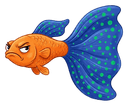
George the Cranky Guppy’s Logbook Card
Guppy · has opinions, mostly about water
George has heard himself described as a beginner fish. He would like to point out that he is small, colourful and hardy, and that none of this makes him simple. He needs warm water, clean water, and company that does not nibble his tail.
He also notes, with some embarrassment, that guppies have a reputation for large families. If you want a tidy tank, ask for males. If you want a lot of guppies, you will not have to ask for anything. It will simply happen.
What goes wrong when choosing a first fish
Buying whichever fish the child points at
Shop tanks are full of young fish that all look small. The one a child points at might be a danio or a baby pleco, and they look alike at 6 cm.
Write a shortlist at home, then let your child choose from it in the shop.
One of each, for variety
A single danio, a single white cloud and a single guppy is three lonely fish. Shoaling fish kept alone hide, stress and nip.
Pick one or two kinds and keep enough of each to make a proper group.
Giving the betta some friends
Fast, nippy fish tear at a betta's long fins, and a second male betta means a fight. Even a female can be chased.
A male betta is happiest as the only fish in his tank.
The goldfish in a bowl
The classic picture, and the classic mistake. A bowl has no room for a proper filter, and a goldfish makes a lot of waste.
If your child loves goldfish, plan a large tank or a pond first, and choose a small tropical fish for now.
Buying an algae eater to do the cleaning
Algae comes from light and leftover food. A fish that eats it does not fix the cause, and the common pleco usually sold for the job outgrows the tank.
Shorten the light hours, feed less, and wipe the glass. It is a nice job for a child.
Questions we get asked
What is the easiest fish for a child to keep?
White cloud mountain minnows are hard to beat. They stay small, live happily without a heater at 18 to 22 °C (64 to 72 °F), and are lively in a group of six. Zebra danios come a close second, but they need a lid because they jump.
Do goldfish grow to the size of their tank?
No. That is a myth. In a small bowl a goldfish is stunted by poor water and crowding, which is a sign of ill health. Given room, a common goldfish can grow past 25 cm (10 inches) and live ten years or more.
Can a betta live with other fish?
Two male bettas will fight, and fast fin-nippers such as tiger barbs will tear a betta's long fins. For a child's first fish, keep one male betta alone in a heated, filtered tank of at least 19 litres (5 US gallons). He will not be lonely.
Are guppies good fish for kids?
Yes, if you keep males only. Male guppies are small, colourful and busy. Females can have a new brood every month or so and store sperm for months, so a mixed group fills a small tank fast. Guppies need a heater at about 24 to 26 °C.
How many fish should a child start with?
For shoaling fish such as white clouds or danios, aim for a group of six, added in two batches of three about two weeks apart so the filter bacteria can keep up. For a betta, the right number is one. Check the tank size before adding more.
What fish don't need a heater?
White cloud mountain minnows are the best choice for an unheated indoor tank, happy at 18 to 22 °C (64 to 72 °F). Zebra danios also cope with a cool room. Goldfish are cold-water fish too, but they need far more space than a first tank gives.
What fish should beginners avoid?
Avoid fish that grow big, such as common goldfish and common plecos. Avoid mixing bettas with fin-nippers or with each other. Avoid female guppies and platies unless you want babies. And avoid adding delicate bottom fish to a tank that has not yet run a month with fish.
How can my child learn more about fish before choosing?
Join our free, parent-led Aquarium Club for Yechiel's eight care guides and printables. For a story, Book 1, The Water Has Opinions, follows a very opinionated guppy, with real water science under the jokes. Reading it before the shop trip makes a good first lesson.
Sources
- Aquarium Basics, Parts 3 and 7Kuperman, Y. Aquarium Basics: Temperature (Part 3 of 9) and How Many Fish? (Part 7 of 9). Yechiel's Fishery Farm care guides (PDF). View source
- FishBaseFroese, R. & Pauly, D. (eds). FishBase species summaries: Xiphophorus maculatus, Betta splendens, Corydoras aeneus. View source
- White cloudWhite Cloud Mountain minnow (Tanichthys albonubes): size to 4 cm, natural range 18–22 °C. View source
- GuppyGuppy (Poecilia reticulata): size by sex, gestation and sperm storage. View source
- Goldfish mythsSPCA New Zealand. Debunking goldfish myths (size, lifespan and bowls). View source
- Goldfish stuntingTropical Fish Hobbyist Magazine. Goldfish Myths Debunked. View sourceNote: Hobby magazine. The mechanism of stunting (waste and growth-inhibiting chemicals) is well described, the exact contribution of each less so.
- Common plecoChewy. Avoid the Pleco Predicament (common pleco adult size compared with the bristlenose). View sourceNote: Adult sizes of 38–60 cm vary between the species sold under the name common pleco.
- betta-sizeChewy. What Size Betta Tank Do I Need? (5 US gallons as the humane minimum for one betta, 76–82 °F). View source
About the author

Yechiel Kuperman
Marine Biologist & Aquaculture Mentor
Yechiel has kept fish since he was four — 49 years with tanks — and 30+ years running farms. He mentors fish farmers internationally.
He writes the Yechiel's Fishery Farm books, in which the biology is real and the fish have opinions.
Last checked: