Do Fish Sleep? How Fish Rest With Their Eyes Open
By Yechiel Kuperman · 49 years with fish
Quick answer
Yes, fish sleep, but not the way people do.
Most fish have no eyelids, so they rest with their eyes open, slowing down, hovering in place or settling near the bottom or among plants.
Scientists studying zebrafish found sleep stages surprisingly like ours, and fish that are kept awake catch up on rest later, just as we do.
The numbers
| What | Number | Why it matters |
|---|---|---|
| Eyelids on a guppy or a goldfish | 0 | So fish sleep with their eyes open |
| Hours a home tank light should be on | 8–10 a day | A dark night lets fish rest, and a light left on feeds algae |
| Kinds of sleep found in zebrafish | 2 | Like our deep sleep and our dreaming sleep |
| How old fish-style sleep may be | at least 450 million years | Older than the dinosaurs, so sleep is very ancient |
| Halves of a dolphin's brain asleep at once | 1 | Dolphins are mammals and must keep breathing air |
Do this — step by step
- Look at the tank quietly at night with only a dim room light on.
- Check that the resting fish is upright and its gills are moving slowly.Slow gills mean a calm fish
- Notice where each fish rests: near the bottom, under a leaf or in a plant.
- Never tap the glass or switch the tank light on suddenly.Turn the room light on first
- Ask a grown-up to put the tank light on a timer for 8 to 10 hours a day.
- Give shy fish plants or a cave so they have somewhere to rest.
- If a fish lies on its side or its gills stop, tell a grown-up straight away.
What does sleep look like for a fish?
Scientists call it sleep when an animal does three things. It goes still, often in its usual resting spot. It is slower to notice what is happening around it. And if it is kept awake, it needs extra rest afterwards. Fish do all three.
Most fish have no eyelids, so they cannot close their eyes. A sleeping fish looks almost awake. Watch for slow, steady breathing through the gills, fins held still, and a fish that hangs in one place or rests on the bottom.
The best-studied sleeping fish is the zebrafish, a small striped fish. In 2007, scientists found that young zebrafish rest mostly at night. When they were kept awake, they rested more the next day, just as a tired child naps after a late night.
In 2019, scientists watched the brains of sleeping zebrafish under a microscope. They found two kinds of sleep, one like our deep sleep and one a little like our dreaming sleep. The scientists think this kind of sleep began at least 450 million years ago.
Different fish sleep in different beds. Some parrotfish wrap themselves in a bubble of slime at night, like a sleeping bag. Scientists found it keeps tiny blood-sucking parasites away while they rest. Some wrasses bury themselves in the sand.
In a home tank, a betta may lie on a leaf near the surface, corydoras catfish rest on the gravel, and many small fish hover among the plants. Many fish turn paler while they rest and colour up again when the light comes on. That is normal.
Not every fish sleeps at night. Some catfish, including plecostomus, rest in caves during the day and come out to feed in the dark. They are the night shift of the tank.
Some sharks have to keep swimming to push water over their gills, so they rest while they move. Others, such as nurse sharks, lie still on the seabed and pump water over their gills instead.
By the way, out in the ocean…
Dolphin. Famous for intelligence and play — dolphins solve problems and call each other by name with signature whistles. Dolphins sleep with one half of the brain at a time so they can keep coming up for air. Fish breathe water, so they can rest without surfacing.
Octopus. One of the ocean's cleverest animals: eight arms, three hearts, and skin that changes colour to vanish in plain sight. Sleeping octopuses flash colours across their skin. Fish often go paler at night instead, so a pale fish at bedtime is usually just resting.
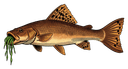
Plecy’s Logbook Card
Plecostomus · the night shift
Plecy would like to clear something up. When you look in the tank at lunchtime and see him wedged in his cave with his eyes open, he is not staring at you. He is asleep. It is his night.
His day starts when your lights go off. That is when he glides out, checks every corner of the glass and does the jobs nobody thanks him for. So please do not tap on his cave to wake him. You would not like it either, and he will remember.
What goes wrong at fish bedtime
Leaving the tank light on all night
Fish need dark to rest properly, and a light left on all the time also grows lots of algae.
A cheap plug timer set to 8 to 10 hours a day solves both problems.
Switching the light on in a dark room
Sudden bright light makes sleepy fish dart about and bump into things.
Turn the room light on first, wait a minute, then turn on the tank light.
Thinking a resting fish is ill
A fish resting on the bottom or looking pale at night is usually fine, as long as it is upright and its gills are moving.
Check again in the morning when the light has been on for a while.
Missing a fish that really is ill
A fish lying on its side, gasping at the top, or still in the same spot all day and night needs help.
Tell a grown-up, who can test the water and look at our guide to fish warning signs.
Tapping the glass to wake a fish up
Tapping sounds much louder underwater and frightens fish.
If you want to see a fish move, wait for feeding time instead.
Questions we get asked
Do fish sleep at night?
Most aquarium fish rest at night, when it is dark, and are busy in the day. A few, such as plecostomus and many catfish, do the opposite: they rest in a cave in the day and come out at night. A tank light on a timer helps every fish keep a steady routine.
Do fish sleep with their eyes open?
Yes. Most fish have no eyelids, so their eyes stay open while they rest. You can tell a fish is resting because it stays still in one place, breathes slowly through its gills and takes a moment to react when something changes near it.
Why is my fish sleeping at the bottom of the tank?
Many fish rest on or near the bottom, especially at night. If the fish is upright, its gills are moving and it swims normally once the light is on, it is just resting. If it stays on the bottom all day or lies on its side, a grown-up should test the water.
Is my fish sleeping or dead?
Look at the gills. A sleeping fish is upright and its gills move slowly. A dead fish has no gill movement and its eyes turn cloudy. Turn the room light on gently first: a sleeping fish usually wakes and moves. If you are not sure, ask a grown-up to check.
Do fish sleep upside down or on their side?
Healthy fish rest upright. A few kinds, like some catfish, may rest at odd angles against a rock or plant. But a guppy, goldfish or betta lying on its side or floating upside down is usually unwell, so tell a grown-up straight away.
Do fish need the light off to sleep?
Yes, darkness helps. Fish follow day and night just as we do. Keep the tank light on for 8 to 10 hours a day and off at night. A light left on all the time stresses fish and grows extra algae on the glass.
Do fish dream?
Nobody knows for sure. Scientists found that zebrafish have a kind of sleep a little like our dreaming sleep, and sleeping octopuses flash colours across their skin. But we cannot ask a fish what it dreamed about, so for now it remains a mystery.
How can my child learn more about fish?
Try our free fish coloring pages, each with a real fish fact, and the free Take It Slow game. Book 1, The Water Has Opinions, is a funny story about a grumpy guppy with real science under the jokes. The free Aquarium Club, joined by a parent, sends Yechiel's care guides.
Sources
- [1] Yokogawa et al. 2007Yokogawa, T. et al. (2007). Characterization of sleep in zebrafish and insomnia in hypocretin receptor mutants. PLoS Biology 5(10): e277. View source
- [2] Leung et al. 2019Leung, L. C. et al. (2019). Neural signatures of sleep in zebrafish. Nature 571: 198–204. View source
- [3] Grutter et al. 2011Grutter, A. S. et al. (2011). Fish mucous cocoons: the 'mosquito nets' of the sea. Biology Letters 7: 292–294. View source
- [4] Medeiros et al. 2021Medeiros, S. L. de S. et al. (2021). Cyclic alternation of quiet and active sleep states in the octopus. iScience 24: 102223. View source
- [5] Rattenborg et al. 2000Rattenborg, N. C., Amlaner, C. J. & Lima, S. L. (2000). Behavioral, neurophysiological and evolutionary perspectives on unihemispheric sleep. Neuroscience & Biobehavioral Reviews 24: 817–842. View source
- [6] National GeographicNational Geographic. Do fish sleep? Here's what scientists have discovered so far. View source
About the author

Yechiel Kuperman
Marine Biologist & Aquaculture Mentor
Yechiel has kept fish since he was four — 49 years with tanks — and 30+ years running farms. He mentors fish farmers internationally.
He writes the Yechiel's Fishery Farm books, in which the biology is real and the fish have opinions.
Last checked: