A Kid's Fish Tank Setup Checklist, Step by Step
By Yechiel Kuperman · 49 years with fish
Quick answer
Set up a child's fish tank in this order: a sturdy stand in the right spot, a rinse with plain water, then gravel, decorations, and tap water treated with conditioner.
Start the filter, give the heater half an hour in the water before switching it on, and put the light on a timer for 8 to 10 hours a day.
Then wait four to six weeks, testing the water and writing the results down, before the first fish arrive.
The numbers
| Checklist item | Metric | US | Why it's on the list |
|---|---|---|---|
| Tank size | 38–75 L | 10–20 US gal | Big enough to forgive a beginner's mistakes |
| Weight of a filled 38 L tank | about 50 kg | about 110 lb | Water alone is 1 kg a litre. Use a stand made for aquariums |
| Heater for a 38 L tank | 30–50 W | 30–50 W for 10 US gal | The usual rule is 3 to 5 watts per US gallon |
| Tropical water temperature | 24–26 °C | 75–79 °F | Steady matters more than the exact number |
| Heater in the water before switching on | about 30 minutes | about 30 minutes | Lets the glass match the water so it does not crack |
| Light on each day | 8–10 hours | 8–10 hours | On a timer. Longer days feed algae |
| Wait before the first fish | 4–6 weeks | 4–6 weeks | Until ammonia and nitrite read zero within a day of a feed |
| Weekly water change | about 10 L from 38 L | about 2.5 US gal from 10 | Roughly a quarter of the water, conditioner in every bucket |
Do this — step by step
- Choose a spot on a level floor, near a socket and away from the window.Kid and grown-up, together
- Put the tank on a stand made for aquariums, never a chest of drawers.Grown-up job
- Rinse the tank, gravel and decorations in plain water, with no soap.Kid job, with a bucket outside the kitchen
- Fill with tap water and add water conditioner to the whole tank.Grown-up measures, kid pours
- Fit the filter and heater, and loop every cable below the socket.Grown-up job. The loop is a drip loop
- Switch on the filter now, and the heater 30 minutes later.
- Set the light timer to 8–10 hours a day.Kid job
- Feed the empty tank a pinch every day or two, and test twice a week.Write every result in a logbook
- Bring fish home only when ammonia and nitrite both read zero.
- Float the bag 15 minutes, then add tank water slowly for 15–20 more.Kid watches the clock
Why does a fish tank have to be set up in this order?
Because each job gets the tank ready for the next one. Skip a box and the problem usually turns up later, often on the day the fish arrive.
The spot comes first because water is heavy. A litre weighs a kilogram, so a 38 litre tank full of water, gravel and glass comes to about 50 kg (110 lb). A stand built for aquariums spreads that load. A bookshelf or chest of drawers can sag or crack.
Sunlight rules out the window. Light plus the leftovers of fish food is exactly what algae needs, and a sunny tank also warms and cools with the day. Fish do best in water that stays steady.
Plain water for rinsing, because soap clings to glass and gravel and harms fish even in traces. Conditioner in the tap water, because the chlorine or chloramine that makes tap water safe for people burns gills. It also kills the filter bacteria the tank is about to grow.
Those bacteria are the reason for the long wait. They live on surfaces, mostly in the filter sponge and the gravel, and they turn fish waste into safer compounds. A new tank has almost none. Feeding the empty tank a pinch of food gives them ammonia to grow on.
Testing twice a week shows them arriving. Ammonia rises first, then nitrite, then both fall to zero while nitrate appears. A child who writes those numbers in a logbook is watching a real nitrogen cycle happen, one line at a time.
The heater waits half an hour after going in so its glass can match the water. For the same reason, it is unplugged before every water change. A hot heater left in the air and then splashed with cooler water can crack.
The drip loop is simple physics. Water runs down a cable. Let the cable dip below the socket before it rises to the plug, and any drip falls off at the lowest point instead of running into the socket.
The last box is the gentlest. Water in a transport bag differs from tank water in temperature and chemistry. Floating the bag and mixing tank water in slowly gives the fish time to adjust, which is the whole point of acclimation.
By the way, out in the ocean…
Jellyfish. Drifting through the sea with no brain and no heart — and some kinds glow with their own light. A jellyfish has no brain and no heart, yet the water around it still decides everything. That's why a tank checklist starts with the water.
Seahorse. The fish that swims standing up — and among seahorses, it is the dads that carry the babies. Seahorses need an expert's saltwater setup. A child's first checklist is for a freshwater tank with a few hardy small fish.
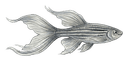
Turbo’s Logbook Card
Zebra danio · has already checked, and checked it twice
Turbo has read your checklist! He read it twice! He has three notes! Stand first, because a full tank is heavier than it looks! Conditioner in every bucket, every time, no exceptions!
And the lid! Danios are jumpers, and Turbo speaks from personal experience of wanting very much to see what is over there! He would also like the heater switched on after thirty minutes, not before! He counted! It was thirty!
What goes wrong on setup day
Putting the tank on whatever furniture is free
A filled 38 litre tank weighs about 50 kg, as much as a small adult. Ordinary furniture is not built to hold that on one spot for years, and a sagging shelf can crack the glass.
Use a stand made for aquariums, on a level floor, and check it with a spirit level before filling.
Washing the gravel with soap
It feels like getting everything properly clean. Soap leaves a film that is hard to rinse away and harmful to fish.
Plain water and a good stir in a bucket is all gravel needs.
Switching the heater on the moment it goes in
Glass heaters can crack when they heat up before settling to the water temperature, or when a hot heater meets cold water in a water change.
Give it thirty minutes in the water first, and unplug it before every water change.
Leaving the light on all day
Children love a lit tank, and fish don't need one for twelve hours. Long days grow green algae on the glass within weeks.
A cheap plug-in timer set for 8 to 10 hours solves it, and nobody has to remember.
Losing track of the tests
Four to six weeks is long, and a test result from last Tuesday is easy to forget. Without the numbers, nobody knows when the tank is ready.
Keep a logbook next to the tank and let your child write the date and every result.
Questions we get asked
What do I need to set up a fish tank for a child?
A 38 to 75 litre tank (10 to 20 US gallons) with a lid, a stand made for aquariums, a filter, a heater for tropical fish, a thermometer, a light on a timer, gravel, water conditioner, a liquid test kit, a bucket used only for the tank, and a notebook for results.
How long does it take to set up a fish tank?
Setup day takes an afternoon: placing the stand, rinsing, filling and switching on. The tank then needs four to six weeks running without fish while filter bacteria grow. Plan the first fish for about a month after setup day, and tell your child the date.
Can I use tap water in a fish tank?
Yes, with water conditioner. Tap water carries chlorine or chloramine, which make it safe to drink and harmful to fish and filter bacteria. Add conditioner to the whole tank when you fill it, and to every bucket at every water change, following the dose on the bottle.
Where should I put my child's fish tank?
On a stand made for aquariums, on a level floor, near a socket and away from windows, radiators and doors that slam. Sunlight grows algae and swings the temperature. Somewhere the child can sit and watch at eye level turns the tank into something they notice every day.
How heavy is a 10 gallon fish tank when it's full?
About 50 kg, or roughly 110 pounds, once water, glass and gravel are counted. Water alone weighs 1 kg per litre, which is about 8.3 pounds per US gallon. That is why a filled tank needs a proper stand and should never be moved with water in it.
How many hours a day should a fish tank light be on?
Eight to ten hours is plenty for fish and most easy plants. Longer days feed algae, which turns the glass green. A plug-in timer keeps the hours the same every day, and fish settle better with a steady day and night than with a light switched on and off at random.
Which fish tank jobs can a child do?
From about five, children can rinse gravel, pour water, feed, read the thermometer, write test results and count fish. The CDC advises that children under five should not clean or handle aquarium equipment. Electrical jobs, water testing and measuring conditioner stay with a grown-up.
Is there a printed version of this checklist?
This page is the checklist, and copying the steps onto a card by the tank works well. For printed advice, Yechiel's eight care guides are free to download as PDFs on our Aquarium Basics pages, and club members get them sent along with new-book news.
Sources
- Aquarium Basics, Parts 5 and 8Kuperman, Y. Aquarium Basics: The Filter (Part 5 of 9) and New Fish and Acclimation (Part 8 of 9). Yechiel's Fishery Farm care guides (PDF). View source
- cdc-fishCenters for Disease Control and Prevention. Fish: Healthy Pets, Healthy People. View source
- Heater sizingAquarium Co-Op. How to Choose the Right Aquarium Heater (3–5 watts per US gallon). View sourceNote: Hobby rule of thumb. A cold room needs the top of the range.
- Heater safetyAquarium Science. 14.8 Aquarium Heaters (placement, and unplugging for water changes). View source
- Drip loopsAlgae Barn. The Importance of Drip Loops. View source
- Tank weightAquifarm. 10 Gallon Fish Tank Weight (about 111 lb filled, with water at about 8.34 lb per US gallon). View sourceNote: Hobby source. The exact figure depends on the glass, gravel and decorations.
- Water conditionersAquarium Science. 5.5.3 Water Conditioners. View source
About the author

Yechiel Kuperman
Marine Biologist & Aquaculture Mentor
Yechiel has kept fish since he was four — 49 years with tanks — and 30+ years running farms. He mentors fish farmers internationally.
He writes the Yechiel's Fishery Farm books, in which the biology is real and the fish have opinions.
Last checked: