A Homeschool Marine Biology Curriculum You Can Actually Run
By Yechiel Kuperman, marine biologist · 49 years keeping fish
Quick answer
This is a nine-week homeschool marine biology curriculum for ages seven to ten, built on three books and the free teacher notes and quizzes written for them.
Each book gets a three-week block of three short sessions a week: read a chapter or two, talk through the science in it, and run one kitchen-table experiment.
It works with siblings of different ages, needs no aquarium, and leaves you with a dated science log that records the work week by week.
Download the printable pack
Chapter-by-chapter science notes, key vocabulary and four low-prep activities for Book 1. The Book 2 and Book 3 notes and all three reading quizzes are free on the Educators page, no email needed.
Book 1 Teacher Notes (week 1 starts here)PDFWhich NGSS standards does this address?
These are performance expectations the unit gives you an opportunity to address — not standards it teaches on its own. Around 44 states use NGSS or standards derived from it, so check these against your own framework.
- 3-LS1-1Develop models to describe that organisms have unique and diverse life cycles but all have in common birth, growth, reproduction, and death.
- 3-LS4-3Construct an argument with evidence that in a particular habitat some organisms can survive well, some survive less well, and some cannot survive at all.
- 4-LS1-1Construct an argument that plants and animals have internal and external structures that function to support survival, growth, behavior, and reproduction.
- 5-LS2-1Develop a model to describe the movement of matter among plants, animals, decomposers, and the environment.
The numbers
| What | Metric | US | Note |
|---|---|---|---|
| Length of the curriculum | 9 weeks · 27 sessions | 9 weeks · 27 sessions | Three books, three weeks each |
| One session | 30–45 min | 30–45 min | Shorter for under-sevens. Stop while it is still fun |
| Reading per session | 1–2 chapters | 1–2 chapters | Each book has 12 chapters, each with its own science focus in the notes |
| Salt-line jar (Book 3 block) | 1 L water · 100 g salt | 1 qt water · about 6 tbsp salt | About three times saltier than the sea, so the line is easy to see |
| Average seawater, for comparison | about 35 g of salt per liter | about 4.7 oz per US gallon | About 3.5% of seawater's weight is dissolved salt |
| Optional home tank | 40–75 L | 10–20 US gal | Only if it can run empty for 4–6 weeks before week 1 |
| Tank temperature (tropical fish) | 24–28 °C | 75–82 °F | Keeping it steady matters more than the exact number |
Do this — step by step
- Print the Book 1 teacher notes and quiz before you open the book.Both are free on the Educators page
- Read one or two chapters a session, then ask that chapter's question from the notes.
- Run one experiment from the notes' Extend It page each week.Egg float, bent straw, salt line and friends
- Start a dated science log on day one and write two lines in it every session.This becomes your record of the work
- Give younger siblings the drawing and word-tracking parts of the quiz, older ones the vocabulary.
- Save the quiz for the last session of each three-week block.
- Take one real observation trip per block: a pond, a public aquarium, or a fish shop's tanks.
- Add a home tank only if it can run empty for four to six weeks first.Fish in an uncycled tank live through the setup
- Move to the next book when your child can explain the last one's big idea to someone else.
What science is in the nine weeks?
One idea runs under the whole curriculum. A fish is always negotiating with the water around it, and each block comes at that from a different side. That is why the books go in order.
Block one is salt. Salinity is just the amount of salt dissolved in water. The open ocean averages about 35 grams per liter, a river carries very little, and where the two meet, in an estuary, you get brackish water that shifts with every tide.
A fish's gills sit right in that water. They are thin enough to take in oxygen, which also makes them thin enough for water and salt to leak across. So the body corrects the balance all day long. The word for that work is osmoregulation.
A freshwater fish is saltier than its water, so water keeps soaking in. It barely drinks, makes lots of dilute urine, and pulls salt back in through its gills.
A marine bony fish has the reverse problem. It loses water to the sea, so it drinks seawater and pumps the extra salt out through special cells in its gills.
Most species can only run one of those systems. A few, called euryhaline, can switch, which is why the molly in Book 1 is at home in fresh, brackish and salt water. Switching still takes time. That is the whole science of acclimation: change the water slowly.
Block two is who eats whom. A mosquito has four life stages, egg, larva, pupa and adult, and the larva and pupa both live in still water. That is where a small fish can eat them before they ever fly. It is biological control, and it is a life cycle your child can draw.
The same block brings in refraction. Light bends where it crosses from air into water, so an insect above the surface is not quite where it looks from below. An archerfish has to correct for that every time it shoots. A pencil in a glass of water shows your child the same bend.
Block three is layers and chemistry you cannot see. Salt water is denser than fresh, so if nothing stirs them, fresh water floats on top and the boundary holds. Oceanographers call it a halocline. Book 3 calls it the salt line.
Then comes waste. Fish give off ammonia, which is toxic. Bacteria in a filter turn it into nitrite, also toxic, and then into nitrate, which is far less harmful. Nothing leaves. It changes form, which is the matter-cycling model 5-LS2-1 asks for.
One correction is worth teaching on purpose. Older books name Nitrobacter as the nitrite-eating bacterium in a freshwater tank. Hovanec and colleagues showed in 1998 that the real worker is a Nitrospira-like bacterium, and Nitrobacter was not detected at all.
So a book on your own shelf may be out of date. Finding that out, and checking it, is the most grown-up science skill in the nine weeks, and eight-year-olds love catching a book being wrong.
By the way, out in the ocean…
Sea turtle. Ancient mariners — their kind has crossed the oceans for over 100 million years, migrating thousands of kilometres. Track one sea turtle's migration on a wall map across the nine weeks, adding a leg of the journey at the end of each block.
Seahorse. The fish that swims standing up — and among seahorses, it is the dads that carry the babies. Seahorse dads carrying the young make a good comparison for the mosquito life cycle in block two. Same four questions, very different answers.
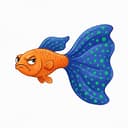
George the Cranky Guppy’s Logbook Card
Guppy · Book 1's reluctant subject
George has been told that children will be studying him at the kitchen table for nine weeks. He has questions. Chiefly, who is doing the dishes.
He wants one thing clear before block one. He was never cranky. He was in the wrong water, which is a different thing entirely, and any child who has been too hot in the back of a car will understand that at once.
His advice for the sessions is the same as his advice for water changes. Go slowly. One chapter is plenty. If the eight-year-old wants to stop after the experiment, stop. Nobody rushes salt, and nobody should rush a fish.
What goes wrong with a homeschool science unit
Reading the whole book first and doing the science afterwards
The teacher notes are keyed chapter by chapter for a reason. A question about gills lands when the fish in the story is struggling to breathe, and it falls flat two weeks later.
Pause at the end of each chapter, ask the one question the notes give for it, and move on. Five minutes is enough.
Pitching everything at the oldest child
The ten-year-old copes and the six-year-old drifts off, and by week three the youngest has decided science is for the others.
The quizzes split cleanly. Word tracking and Think & Draw suit five- and six-year-olds. Vocabulary matching and fill-in-the-blanks suit seven and up. Give each child their own parts of the same sheet.
Buying a fish tank because the unit starts on Monday
A new tank has no established filter bacteria, so ammonia builds up with nothing to remove it. Fish added in week one live through that, and many do not.
The curriculum needs no tank at all. If you want one, set it running empty four to six weeks before you start, and let the cycling become part of block three.
Marking the drawing
Each quiz ends with Think & Draw: a few sentences of the child's own and a picture. The answer key says any thoughtful response and drawing earns full marks. Take it at its word.
A child who gets a red cross on a drawing learns to stop drawing.
Turning the science log into homework
A log that has to be neat and complete gets abandoned by week two. Two dated lines per session is plenty: what we did, what we noticed.
Keep the failed experiments in it. A salt line that mixed because someone bumped the table is real data, and Book 3's teacher notes are built around exactly that habit of writing mistakes down.
Questions we get asked
Is this homeschool marine biology curriculum free?
The plan on this page, the teacher notes and the reading quizzes are all free PDFs, with no account and no email address needed.
The three books are not free. You can buy them or ask your library to order them, and the notes are written so they still make sense before a child has read the story.
What age is this marine biology curriculum for?
It is written for ages seven to ten, which is who the books and teacher notes were built for.
Five- and six-year-olds can join in with the read-aloud, the experiments and the drawing parts of the quizzes. Eleven- and twelve-year-olds can take on the measuring, the graphing and explaining each block to a younger sibling.
Do we need an aquarium for homeschool marine biology?
No. Every experiment in the teacher notes uses kitchen equipment: an egg, salt, a glass of water, a straw, a plastic bottle, some string.
A home tank adds real water testing, which is excellent in block three. It has to be set up and running empty for four to six weeks before any fish go in.
Can I teach this to several children at once?
Yes, and it is designed for that. Everyone hears the same chapter and does the same experiment together.
Only the written work splits by age. Younger children take the word-tracking and drawing parts of the quiz, while older ones take the vocabulary and fill-in sections. Each child keeps their own log, even if it is mostly pictures.
Does this curriculum cover NGSS standards?
It gives you an opportunity to address four life-science performance expectations, listed on this page in their official wording.
We say opportunity on purpose. A unit does not teach a standard by itself, and many families follow a different framework or none at all, so check it against whatever your own plan uses.
How do I keep a record of homeschool science work?
The dated science log is the record. Add the finished quizzes, a photo of each experiment and a short note at the end of every block about what your child can now explain.
What counts as a record, and whether you need one, depends on where you live, so check your own requirements.
How is this different from your classroom lesson plans?
The classroom lesson plans are built around a school aquarium and forty-five-minute lessons for a class of twenty-five.
This curriculum drops the tank, uses shorter sessions, and plans for mixed ages at one table. The books and teacher notes are the same, so moving between the two versions is easy.
What should we do after the nine weeks?
Book 4, The Fizzy Bog Mystery, is out, but it does not have teacher notes yet, so read it for the story and let your child spot the science.
For more hands-on work, our page of eight no-tank ocean activities adds buoyancy, sound, camouflage and a proper survey count.
Sources
- NGSSNGSS Lead States (2013). Next Generation Science Standards: For States, By States. Performance-expectation wording quoted from nextgenscience.org. View sourceNote: Many states and most homeschool plans use other frameworks. Check alignment against the one you follow.
- Evans et al. 2005Evans, D. H., Piermarini, P. M. & Choe, K. P. (2005). The multifunctional fish gill: dominant site of gas exchange, osmoregulation, acid-base regulation, and excretion of nitrogenous waste. Physiological Reviews 85(1), 97–177. View source
- USGSU.S. Geological Survey. Why is the ocean salty? USGS FAQ (seawater averages about 35 parts per thousand dissolved salt). View source
- CDCCenters for Disease Control and Prevention. Life Cycle of Aedes Mosquitoes (egg, larva, pupa, adult; larvae and pupae live in water). View source
- Hovanec et al. 1998Hovanec, T. A., Taylor, L. T., Blakis, A. & DeLong, E. F. (1998). Nitrospira-like bacteria associated with nitrite oxidation in freshwater aquaria. Applied and Environmental Microbiology 64(1), 258–264. View source
About the author

Yechiel Kuperman
Marine Biologist
Yechiel has kept fish since he was four — 49 years with tanks — and 30+ years running farms.
He writes the Yechiel's Fishery Farm books, in which the biology is real and the fish have opinions.
Last checked: